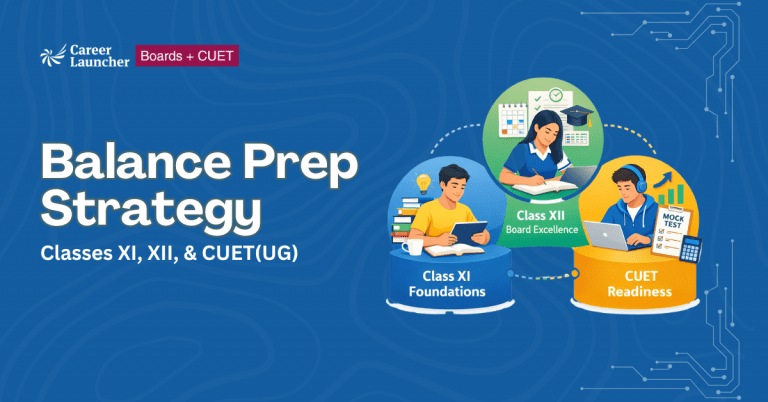
Class 12 is an important year. Along with your Board examinations, you may also be preparing for CUET UG to secure admission to your preferred university and undergraduate program. But, how to prepare for Boards and CUET together? Managing both exams can be challenging, especially when you have to complete the syllabus, revise chapters, solve sample papers and practice MCQs.
But here is the good news: you do not need two completely different preparation plans if you know how to balance CUET preparation with Boards effectively.
A large part of your domain subject preparation can overlap. Your NCERT textbooks, classroom learning and conceptual understanding can help you prepare for both exams. The key is to understand how each exam tests your knowledge and adjust your study plan accordingly.
The right approach is to balance CUET preparation with Boards by combining your regular school studies with focused MCQ practice, timed tests and revision. This way, you can prepare for both exams without cluelessly juggling between the two.
In this guide, we explain how to prepare for Boards and CUET together, how many hours to study, what to prioritize and how to follow a realistic timetable for CUET UG.
Table of Contents
Can You Prepare for CUET UG While Studying for Class 12 Boards?
Yes. Class 12 students can prepare for CUET UG alongside their Board exams by combining their domain-subject preparation and practicing the different question formats required by each exam.
Both exams test your understanding of subjects studied in school, particularly for CUET domain subjects. However, their assessment styles are different.
| Class 12 Board Exams | CUET UG |
|---|---|
| Focus on descriptive and written answers, depending on the subject and paper pattern. | Focuses on objective-type questions (MCQs). |
| Tests your ability to explain concepts, show working and present answers clearly. | Tests conceptual understanding, accuracy and the ability to answer within a limited time. |
| Requires written practice, step-by-step solutions and structured answers. | Requires MCQ practice, time management and familiarity with the test format. |
| Preparation involves textbooks, notes, sample papers and previous-year papers. | Preparation involves the prescribed CUET syllabus, MCQs, mock tests and previous-year questions. |
The biggest advantage is that learning a chapter for Boards can also strengthen your CUET preparation. You only need to add focused MCQ practice, timed tests and regular revision to make your preparation more complete.
How to Balance CUET Preparation with Boards: 6 Practical Strategies
Balancing both examinations is not about dividing your time equally between them every day. It is about reviewing the Boards & CUET syllabus and identifying common topics, prioritizing your immediate academic requirements and making your study sessions more productive.
Follow these six strategies to manage your preparation effectively.
1. Understand the Syllabus and Subject Requirements First
Before starting your preparation, understand what both examinations require.
For Boards, follow your respective Board’s prescribed syllabus and examination pattern. For CUET UG 2027, refer to the official NTA syllabus and check the subject requirements of the universities and programs you are targeting.
Do not assume that every university requires the same combination of CUET subjects. The subjects you need to appear for can vary depending on your preferred course and university.
Make a subject-wise checklist and divide the syllabus into three categories:
- Common topics: Topics that are part of both your Class 12 subject preparation and the relevant CUET domain syllabus.
- Board-focused practice: Topics or question formats that need more descriptive writing, derivations, explanations or step-by-step solutions.
- CUET-focused practice: Topics that need additional MCQ practice, quick recall, accuracy and timed question-solving.
This simple exercise will help you avoid studying the same concepts twice.
2. Use NCERT as Your Primary Study Resource
For students appearing in CUET domain subjects, NCERT is an important preparation resource. Many domain subject topics are aligned with the Class 12 curriculum, making your regular Board preparation useful for CUET as well.
While studying a chapter, focus on:
- Understanding every important concept rather than memorising answers.
- Reading definitions, facts, examples, diagrams and explanations carefully.
- Solving NCERT in-text and exercise questions.
- Revising important formulas, dates, terms and concepts.
- Identifying topics that need additional MCQ practice.
However, is NCERT enough for CUET UG 2027? It is a strong starting point for domain subjects, but students should not depend on NCERT alone without checking the official CUET syllabus. You also need to practice objective questions, understand the examination format and prepare the Language and General Aptitude Test sections if required for your chosen programs.
3. Prepare for Boards First, Then Add CUET Practice
You do not have to choose between Board preparation and CUET preparation. Instead, follow a chapter-wise approach.
For every chapter:
- Study the concepts from your NCERT textbook and class notes.
- Make short notes containing key definitions, formulas and important points.
- Solve textbook exercises and Board-style questions.
- Practice CUET-level MCQs based on the same chapter.
- Review incorrect answers and revise the concepts behind them.
For example, if you are studying a chapter in Accountancy, first understand the concepts and practice the relevant numerical questions. Once you are comfortable, solve MCQs from the same chapter under a time limit.
This approach helps you build conceptual clarity for Boards while developing the speed and accuracy needed for CUET.
4. Give Equal Importance to Revision and Practice
Completing the syllabus is only one part of preparation. You must also revise regularly to retain what you have studied.
A practical revision routine can include:
- Daily revision: Spend 20-30 minutes revising topics covered during the day.
- Weekly revision: Revisit important concepts and solve questions from completed chapters.
- Monthly revision: Take a subject-wise test to identify weak areas.
- Before examinations: Focus on short notes, important concepts, formulas and frequently made mistakes.
Do not wait until the entire syllabus is complete to begin revision. Regular revision will reduce the pressure of covering everything at the last minute.
5. Start CUET MCQ Practice Alongside Your Board Preparation
One of the biggest differences between Boards and CUET is the way you answer questions. Even if you understand a chapter thoroughly, you may need practice to identify the correct MCQ option quickly.
Start with chapter-wise MCQs and gradually move towards sectional tests and full-length CUET mock tests.
Your CUET practice should focus on:
- Understanding the question before selecting an answer.
- Eliminating incorrect options.
- Improving speed without compromising accuracy.
- Identifying concepts you repeatedly get wrong.
- Learning to manage time across questions.
Do not turn every study session into a mock test. During the initial stages, chapter-wise practice is more useful. Increase the frequency of timed tests as you complete more of the syllabus.
Also refer to and solve – CUET Previous Year Papers & CUET Sample Papers
6. Keep Language and General Aptitude Test Preparation in Your Plan
Students often focus heavily on their domain subjects and leave the Language and General Aptitude Test sections for later. If your preferred university programs require these papers, include them in your weekly timetable from the beginning.
For Language preparation, practice reading comprehension, vocabulary, grammar and verbal ability as prescribed in the official syllabus. For the General Aptitude Test, work on the relevant areas of general knowledge, current affairs, logical reasoning, quantitative reasoning and numerical ability.
The exact combination of subjects you need to prepare for should be based on the admission requirements of your target universities and programs.

How Many Hours Should You Study for Boards and CUET?
There is no fixed number of study hours that works for every student. Your daily study time should depend on your school schedule, syllabus completion, subject difficulty and preparation level.
However, a focused study routine of around 4-6 hours outside school can be a practical starting point for many Class 12 students. You can adjust it depending on your workload and upcoming examinations.
Here is an illustrative daily study plan:
| Activity | Suggested Time |
|---|---|
| School, homework or Board-focused study | 2 hours |
| NCERT and concept revision | 1 hour |
| CUET MCQ practice | 45 minutes |
| Language or General Aptitude Test practice (if required) | 30 minutes |
| Revision and error analysis | 30 minutes |
| Total | 4 hours 45 minutes |
This is a suggested routine, not a compulsory target. On days with school tests, practical work or heavy assignments, you can reduce your CUET practice and prioritize your immediate academic requirements.
The objective is to maintain consistency rather than study for long hours without a clear plan.
Also Read: CUET 2027 Preparation Strategy
CUET Preparation Timetable for Class 12 Students
Your preparation timetable should change as you move closer to the Board and CUET examinations. Instead of following the same routine throughout the year, divide your preparation into three phases.
Phase 1: Build Your Foundation (November 2026 – January 2027)
This phase should focus on completing your school syllabus and developing a strong understanding of the concepts.
What to do:
- Follow your school teaching schedule and complete NCERT chapters.
- Prepare short notes for every subject.
- Solve textbook exercises and Board-style questions.
- Start chapter-wise CUET MCQ practice.
- Practice Language and General Aptitude Test topics if required.
- Take a short subject-wise test every week.
Your target: Complete a substantial portion of the syllabus while developing a regular CUET practice habit.
Phase 2: Prioritize Board Examinations (February – April 2027)
As the Board examinations approach, your priority should shift towards Board preparation. The CBSE Class 12 Board examinations are scheduled from February 16 to April 9, 2027. Students from other Boards should follow their respective examination schedules.
What to do:
- Revise the complete syllabus according to your Board timetable.
- Solve sample papers and previous-year Board questions.
- Practice writing answers within the prescribed time.
- Revise important formulas, definitions and concepts.
- Continue light CUET MCQ practice whenever your Board workload permits.
Your target: Perform well in Boards without completely losing touch with CUET question practice.
Phase 3: Focus on CUET Preparation (After Your Board Exams)
Once your Board examinations are over, you can shift your primary focus to CUET UG 2027. The current NTA examination page lists May-June 2027 as the CUET UG examination window. Check the official NTA website for the latest schedule and updates.
What to do:
- Revise all the subjects you have selected for CUET.
- Practice chapter-wise and full-length MCQs.
- Take timed mock tests regularly.
- Analyze your performance after every mock.
- Revise weak topics and frequently incorrect questions.
- Practice managing time and accuracy during the test.
Your target: Improve your speed, accuracy and confidence through focused practice before the examination.
How to Manage Board Exams and CUET Mock Tests?
Mock tests are important for CUET preparation, but taking too many tests without analysing them can waste valuable study time. Your mock test frequency should increase gradually as your syllabus progresses.
| Preparation Stage | Recommended Practice |
|---|---|
| Initial preparation | Chapter-wise MCQs and short topic tests |
| After completing a few chapters | Subject-wise sectional tests |
| Once most of the syllabus is complete | One full-length mock test every 1-2 weeks |
| During the final CUET preparation phase | Two or more full-length mocks per week, depending on your revision and analysis time |
After every mock test, spend time understanding your performance.
Check:
- Which questions did you answer incorrectly?
- Which questions took too long?
- Which topics need further revision?
- Did you make mistakes because of weak concepts or careless reading?
- Did you manage the available time effectively?
Maintain an error notebook and revisit it regularly. Learning from your mistakes is more useful than simply increasing the number of mock tests. During the peak Board examination period, reduce or pause full-length CUET mocks if they interfere with your Board revision. You can maintain continuity through short MCQ practice sessions instead.
Enroll in the CUET Test Series by Career Launcher for intensive practice and detailed feedback and analysis by experts, providing valuable insights to improve your exam-day performance.
What Should You Study First: Boards or CUET?
Start with your Class 12 concepts and NCERT syllabus, then integrate CUET-specific practice into your preparation.
Your Board preparation provides the conceptual foundation for many CUET domain subjects. Once you understand a topic, practice the corresponding CUET MCQs to become familiar with the objective examination format.
A useful sequence is:
- Complete the chapter from NCERT.
- Understand important concepts and examples.
- Solve Board-oriented questions.
- Practice CUET MCQs from the same chapter.
- Revise the chapter and analyze your mistakes.
This method ensures that your Board preparation contributes to CUET rather than becoming a separate workload.
Is CUET Preparation Different from Class 12 NCERT?
Yes, there are some differences, but they do not mean that you need to study everything from scratch.
NCERT and your Class 12 curriculum help you develop subject knowledge. CUET preparation requires you to apply that knowledge in an objective, time-bound examination.
Here is what you need to add to your regular NCERT preparation:
| NCERT and Board Preparation | Additional CUET Preparation |
|---|---|
| Reading and understanding chapters | Practicing objective questions from the prescribed CUET syllabus |
| Solving descriptive questions | Solving MCQs within a time limit |
| Writing detailed answers | Selecting the correct option accurately |
| Revising textbook concepts | Revising through chapter-wise tests and mock tests |
| Practising Board sample papers | Solving CUET previous-year questions and mock tests |
Therefore, your NCERT preparation should form the foundation, while CUET-specific practice should help you adapt to the entrance examination.
How Many Months Are Enough to Prepare for CUET UG 2027?
The preparation time required depends on your current academic level, syllabus coverage and target subjects. If you are already studying Class 12 subjects regularly, you do not necessarily need to follow a completely separate CUET preparation plan.
As a broad planning guide:
- 6-8 months: Suitable for students who want to build concepts, complete the syllabus and practice MCQs gradually alongside Boards.
- 3-5 months: Requires a more structured timetable, focused revision and regular sectional tests.
- 1-2 months: Requires prioritizing the prescribed syllabus, revising important topics and taking timed mock tests. Students should focus on their weaker areas instead of trying to study everything from scratch.
These are planning estimates, not guaranteed preparation timelines. Your progress and consistency matter more than the number of months.
Common Mistakes to Avoid While Preparing for Boards and CUET
Even a well-planned timetable can become ineffective if you make avoidable preparation mistakes.
Watch out for these common mistakes:
- Preparing for both examinations separately: Avoid studying the same chapter twice. Use your NCERT preparation as the foundation for CUET domain subjects.
- Ignoring the official CUET syllabus: Do not assume that everything in your school syllabus automatically matches the CUET syllabus.
- Postponing MCQ practice: Start practising objective questions early instead of waiting until your Board examinations are over.
- Taking too many mock tests: Mock tests are useful only when you analyze your mistakes and revise accordingly.
- Ignoring Language and General Aptitude Test sections: Prepare these components if they are required for your target university programs.
- Following an unrealistic timetable: A practical routine that you can follow consistently is better than a demanding schedule that you abandon after a few days.
- Neglecting sleep and breaks: Proper rest helps you maintain concentration and retain what you study.
How CL Can Help You Effectively Prepare for CUET UG
Preparing for Boards and CUET together becomes easier when you have the right study resources, practice material and guidance. Career Launcher offers appropriate support with CUET online coaching catering to individual students strengths helping them with their concepts through intensive classes, practice exam-oriented questions through mocks, and assess their preparation with analysis and feedbacks.
With structured learning resources, subject-wise practice, full-length mock tests and performance analysis, you can identify areas that need improvement and prepare more systematically.
Whether you are beginning your CUET preparation or looking to improve your performance after completing your Board syllabus, the right guidance can help you stay focused on your admission goals.
Frequently Asked Questions (FAQs)
1. How to prepare for Boards and CUET together?
To prepare for Boards and CUET together, use NCERT and your Class 12 syllabus as the foundation for domain subjects. First understand each chapter, practice Board-style questions and then solve CUET MCQs from the same topics. Add regular revision, sectional tests and mock tests to your timetable.
2. How to balance CUET preparation with Boards?
To balance CUET preparation with Boards, combine your NCERT-based domain subject preparation and Board studies. Prioritize your school syllabus, practice CUET MCQs from completed chapters, revise regularly and adjust your mock test frequency according to your Board examination schedule.
3. Can I prepare for CUET while studying for Class 12 Boards?
Yes. You can prepare for CUET while studying for Class 12 Boards because much of the domain subject preparation overlaps. Focus on your school syllabus and NCERT concepts, and gradually add CUET-specific MCQ practice, timed tests and revision.
4. How many hours should I study for Boards and CUET?
A focused study routine of around 4-6 hours outside school can be a practical starting point for many students. Divide this time between NCERT study, Board preparation, CUET MCQ practice and revision. Adjust your schedule according to your school workload and preparation level.
5. Is NCERT enough for CUET UG 2027?
NCERT is an important preparation resource for CUET domain subjects, but students should also check the official CUET UG 2027 syllabus. They should practice MCQs, previous-year questions and mock tests, and prepare for the Language or General Aptitude Test sections if required for their chosen programs.
6. When should Class 12 students start preparing for CUET?
Class 12 students should ideally begin preparing for CUET alongside their regular school studies. Starting early allows them to build conceptual clarity, complete the syllabus gradually and practice MCQs without creating additional pressure during the Board examination period.
7. What is the best CUET preparation timetable for Class 12 students?
A good CUET preparation timetable should include daily NCERT study, Board-oriented question practice, chapter-wise CUET MCQs and regular revision. Students should gradually introduce sectional tests and full-length mock tests as they complete their syllabus.
8. How to manage Board exams and CUET mock tests?
Prioritize Board preparation during the peak examination period and maintain CUET practice through short MCQ sessions. Before Boards, take sectional and occasional full-length CUET mocks depending on your syllabus progress. After Boards, increase full-length mock tests and analyze your performance regularly.
9. What should I study first: Boards or CUET?
Start with your Class 12 NCERT concepts and Board syllabus, as they provide the foundation for many CUET domain subjects. Once you understand a chapter, practice CUET MCQs from the same topic to develop speed and accuracy.
10. How many months are enough to prepare for CUET UG 2027?
The required preparation time depends on your syllabus coverage and academic foundation. Students who start early can prepare gradually over 6–8 months, while those with less time need a focused plan involving syllabus revision, MCQ practice and mock tests.
11. Can I crack CUET 2027 with Boards preparation alone?
Board preparation can provide a strong foundation for CUET domain subjects, but it may not be sufficient on its own. CUET requires objective-question practice, time management and familiarity with the examination format. Students should also prepare the Language and General Aptitude Test sections if required by their target programs.
12. Is CUET preparation different from Class 12 NCERT?
Yes. NCERT helps you understand the subject concepts, while CUET preparation focuses on applying that knowledge to objective-type questions within a limited time. Therefore, students should combine NCERT study with MCQ practice, previous-year questions and mock tests.
13. How can I prepare for CUET UG 2027 after my Board exams?
After your Board examinations, focus on revising the CUET syllabus, practising subject-wise MCQs and taking full-length mock tests. Analyze your performance after every test, work on weak topics and revise important concepts regularly.