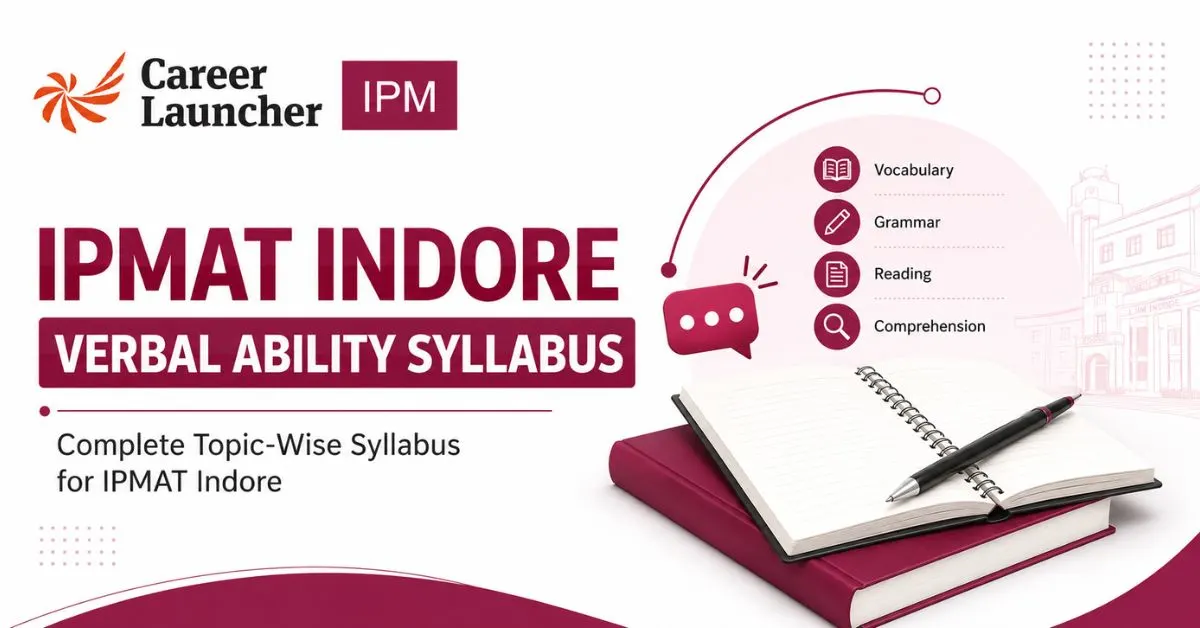
If you’re dreaming of joining IIM Indore’s 5-year IPM program, you cannot afford to take the IPMAT Indore Verbal Ability syllabus lightly. Here’s the number that should stop you in your tracks: Verbal Ability alone decides 50% of your final Aptitude Test Score (ATS) in IPMAT Indore. It’s official, and it changes how you should plan your entire IPMAT preparation.
Most aspirants invest hours into Quant and treat Verbal Ability as an afterthought. That’s a costly mistake. In IPMAT Indore, VA isn’t just “one more section” – it’s the single highest-weighted section in the whole exam, and it has more questions than either Quant section too.
This blog breaks down everything you need to know – the complete IPMAT Indore VA topic list, topic-wise weightage, exam pattern, and a preparation roadmap that actually works.
Table of Contents
IPMAT Indore 2027 Verbal Ability Syllabus Highlights
The IPMAT Indore syllabus for Verbal Ability is built around four broad topic areas. Here’s the quick highlight table before we elaborate on each:
|
Topic Area |
Approx. Questions | Weightage |
| Reading Comprehension (RC) | 12–18 |
40–50% |
|
Vocabulary |
8–12 | 20–25% |
| Grammar & Sentence Correction | 5–8 |
15–20% |
|
Verbal Reasoning |
5–10 |
15–20% |
The takeaway is simple: Reading Comprehension alone can decide almost half your VA score. If RC is your weak spot, fixing it should be priority number one.
IPMAT Indore VA Syllabus: Important Topics
Let’s break down each topic area from the official IPMAT Indore VA syllabus, along with what it actually tests and why it matters.
1. Reading Comprehension (RC) – The Heavyweight Topic
RC is the backbone of the IPMAT Indore Reading Comprehension syllabus, and it’s also where IPMAT Indore does something different from most other management entrance exams: many passages are conversation-based rather than plain essay-style writing. That means you need to follow dialogue, tone shifts, and implied meaning – not just static facts.
Each test typically has 2-4 passages, each around 300-500 words long, generating 12-15 questions in total. The sub-topics you’ll be tested on include:
- Main idea and central theme of the passage
- Inference-based questions (what is implied, not stated)
- Author’s tone and intent
- Fact vs. opinion distinction
- Specific detail and reference-based questions
- Vocabulary in context
- Strengthening or weakening a given argument
Because passages are conversational, practice reading dialogues, interviews, and opinion-style pieces – not just formal essays – to get comfortable with the format.
2. Vocabulary – Building Your Word Power
The IPMAT Indore Vocabulary syllabus tests how wide and how precise your English word bank is. Expect 8-12 questions from this area, covering:
- Synonyms and Antonyms
- Idioms and Phrases
- One-Word Substitution
- Phrasal Verbs
- Confusable Words (commonly mixed-up word pairs)
- Odd One Out
- Word Roots and Etymology
- Spelling Errors
Learning words in isolation rarely sticks. Learn word roots and prefixes instead – one root often unlocks 8-10 related words at once, which is far more efficient closer to exam day.
3. Grammar & Sentence Correction – Precision Matters
This part of the syllabus rewards students who know English grammar rules cold, not just “by ear.” Expect 5-8 questions covering:
- Subject-Verb Agreement
- Tenses
- Articles and Prepositions
- Modifiers
- Parallelism
- Active–Passive Voice
- Direct–Indirect Speech
- Error Spotting
Grammar questions are high-accuracy opportunities – once you know a rule, you rarely get it wrong again. This makes Grammar one of the most “learnable” and scorable parts of the entire IPMAT VA syllabus.
4. Verbal Reasoning – Logic Meets Language
This section blends logic with language skills, testing how well you understand structure and flow in written English. It typically carries 5-10 questions, covering:
- Para Jumbles
- Para Summary / Para Completion
- Sentence Rearrangement
- Cloze Test
These questions test comprehension of flow and logical sequencing rather than vocabulary or grammar rules – so practice is about pattern recognition, built through repeated timed practice.
IPMAT Indore Verbal Ability Syllabus: Topic-Wise Weightage
Here is the complete, detailed breakdown of IPMAT Indore Verbal Ability syllabus sub-topics, approximate questions, and topic-wise weightage for the IPMAT Indore VA syllabus:
|
Topic Area |
Key Sub-topics | Questions | Weightage |
| Reading Comprehension | Conversation-based passages, Main idea, Inference, Tone, Fact vs Opinion, Vocabulary in Context, Argument Strengthening/Weakening | 12-18 |
40–50% |
|
Vocabulary |
Synonyms/Antonyms, Idioms, One-Word Substitution, Phrasal Verbs, Confusable Words, Odd One Out, Word Roots, Spelling | 8-12 | 20–25% |
| Grammar & Sentence Correction | SVA, Tenses, Articles, Prepositions, Modifiers, Parallelism, Active-Passive, Direct-Indirect, Error Spotting | 5-8 |
15–20% |
|
Verbal Reasoning |
Para Jumbles, Para Summary/Completion, Sentence Rearrangement, Cloze Test | 5-10 |
15–20% |
A simple way to use this table: allocate your weekly study hours roughly in proportion to the weightage – meaning RC and Vocabulary together should take up more than half your IPMAT VA prep time.

IPMAT Indore Verbal Ability Question Pattern
Understanding the IPMAT Indore VA question pattern is just as important as knowing the topics. Here’s how the section is structured:
|
Parameter |
Details |
| Total Questions |
45 |
|
Question Type |
MCQ (4 options each) |
| Marks per Correct Answer |
+4 |
|
Negative Marking |
-1 per incorrect answer |
| Total Marks (VA Section) |
180 |
|
Sectional Time Limit |
40 minutes (fixed, cannot be extended) |
| Number of RC Passages |
2–4 passages, 300–500 words each |
|
Exam Mode |
Computer-Based Test (CBT), English medium only |
| Calculator Allowed |
No |
Also read: IPMAT Indore Exam Pattern
Strategy note: Unlike the QA Short Answer section, VA carries standard negative marking on every question – so avoid random guessing on questions you’re genuinely unsure about, especially in Grammar and Vocabulary.
IPMAT Indore Verbal Ability Preparation Tips
Knowing the syllabus is only half the job done. Converting it into an effective IPMAT preparation plan is the rest. Here’s how to actually convert it into a disciplined IPMAT Verbal Ability preparation strategy and high VA score:
Build a Daily Reading Habit
- Read one editorial daily from The Hindu, The Indian Express, or The Economist.
- Focus on understanding tone, argument, and structure – not just meaning.
- Note down 5 new words from every article you read.
Approach Reading Comprehension Strategically
- Practice 2 RC passages every single day – no exceptions.
- Specifically practice conversation-based and dialogue-style passages, since these are distinctive to IPMAT Indore.
- After each passage, review every wrong answer to understand the trap, not just the correct option.
Strengthen Vocabulary the Smart Way
- Solve 10 vocabulary questions daily.
- Learn words through roots and prefixes instead of random word lists.
- Revise confusable word pairs weekly – they’re a favourite trap in MCQs.
Master Grammar Rules Conceptually
- Revise one grammar rule at a time and drill it with 15–20 practice questions.
- Keep an error log of grammar mistakes you repeat, and revisit it weekly.
Practice Sectional Mocks Under Real Conditions
- Take timed sectional mocks of exactly 40 minutes to build the stamina IPMAT Indore’s strict sectional limit demands.
- Take a minimum of 15–20 full-length mocks in the final phase of preparation.
- Always do a post-mock analysis – identify patterns in your errors, not just the individual mistakes.
Career Launcher’s free IPMAT mock test replicates the strict 40-minute sectional format, so the stamina and pacing you build in practice carry over directly to exam day.
IPMAT Indore Syllabus
Here’s the bigger picture. The IPMAT Indore syllabus 2027 is split into three sections:
- Quantitative Ability – Short Answer (QA SA): 15 questions with typed numerical answers, no options given, and zero negative marking.
- Quantitative Ability – MCQ (QA MCQ): Standard quant MCQs with four answer choices.
- Verbal Ability – MCQ (VA MCQ): 45 MCQs testing Reading Comprehension, Vocabulary, Grammar, and Verbal Reasoning.
In total, IPMAT Indore has 90 questions worth 360 marks, to be attempted in 120 minutes, with a strict 40-minute sectional time limit for each part. You cannot borrow time from one section to finish another – which makes VA speed and accuracy non-negotiable.
|
Section |
Question Type | No. of Questions | Marks | Negative Marking |
| QA – Short Answer | Typed numerical answer | 15 | 60 |
None |
|
QA – MCQ |
MCQ (4 options) | 30 | 120 | +4 / -1 |
| Verbal Ability – MCQ | MCQ (4 options) | 45 | 180 |
+4 / -1 |
|
Total |
— | 90 | 360 |
120 min overall | 40 min/section |
Did you notice that the Verbal Ability alone is worth as much as both Quant sections combined (180 out of 360 marks)? That single fact should tell you exactly where your preparation hours need to go.
Make IPMAT Verbal Ability Your Strength, Not an Afterthought
The IPMAT Indore Verbal Ability syllabus isn’t just another section to tick off – it’s the section that decides half your final score. With 45 questions spread across Reading Comprehension, Vocabulary, Grammar, and Verbal Reasoning, VA rewards students who prepare consistently rather than those who cram at the last minute.
Reading Comprehension is your biggest opportunity (and biggest risk) with direct 50% weightage within the IPMAT VA syllabus. Vocabulary and Grammar are highly learnable and offer quick wins once the rules and concepts are learned thoroughly, and Verbal Reasoning rewards structured, timed practice.
Start early, read daily, track your accuracy topic-wise, and treat every mock test as feedback rather than just a score. Do that consistently, and the IPMAT Indore Verbal Ability syllabus can become your biggest scoring advantage – not your biggest worry.
For students who want structured accountability alongside this plan, Career Launcher’s IPMAT Indore online coaching is built around the same RC-first, weightage-driven strategy.
FAQs About IPMAT Indore Verbal Ability Syllabus
- What is the IPMAT Indore Verbal Ability syllabus?
The IPMAT Indore Verbal Ability syllabus covers Reading Comprehension, Vocabulary, Grammar & Sentence Correction, and Verbal Reasoning, tested through 45 MCQs.
- How many questions are asked in the IPMAT Indore VA section?
The Verbal Ability section has 45 MCQ-based questions, making it the largest single section in IPMAT Indore by question count.
- What is the weightage of Verbal Ability in IPMAT Indore?
Verbal Ability carries 50% weightage in IIM Indore’s final Aptitude Test Score (ATS), making it the single most important section for selection.
- Is there negative marking in the IPMAT Indore Verbal Ability section?
Yes. Like the QA-MCQ section, VA follows a +4 for correct and -1 for incorrect answer marking scheme. Only the QA Short Answer section has no negative marking.
- What type of Reading Comprehension passages appear in IPMAT Indore?
IPMAT Indore is known for conversation-based RC passages, alongside standard essay-style passages, typically 300–500 words long.
- How many RC passages appear in the IPMAT Indore VA section?
Candidates can expect 2 to 4 Reading Comprehension passages, generating a total of 12–18 questions.
- What is the sectional time limit for Verbal Ability in IPMAT Indore?
Each section, including Verbal Ability, has a fixed 40-minute sectional time limit within the overall 120-minute exam duration.
- Which topics should I prioritize in IPMAT Indore Verbal Ability?
Reading Comprehension deserves the most attention since it carries 40–50% weightage within VA, followed by Vocabulary and then Grammar and Verbal Reasoning.
- How is IPMAT Indore VA different from IPMAT Rohtak VA?
The topic areas are similar, but IPMAT Indore’s VA is generally considered more challenging and carries a higher weightage (50% of ATS) compared to IPMAT Rohtak, where VA is one of three equally structured sections alongside Quant and Logical Reasoning.
- What is the best way to prepare for IPMAT Indore Verbal Ability?
Read editorials daily, practice RC passages (including conversation-based ones) consistently, build vocabulary through word roots, revise grammar rules thoroughly, and take regular sectional mocks under the 40-minute time limit.