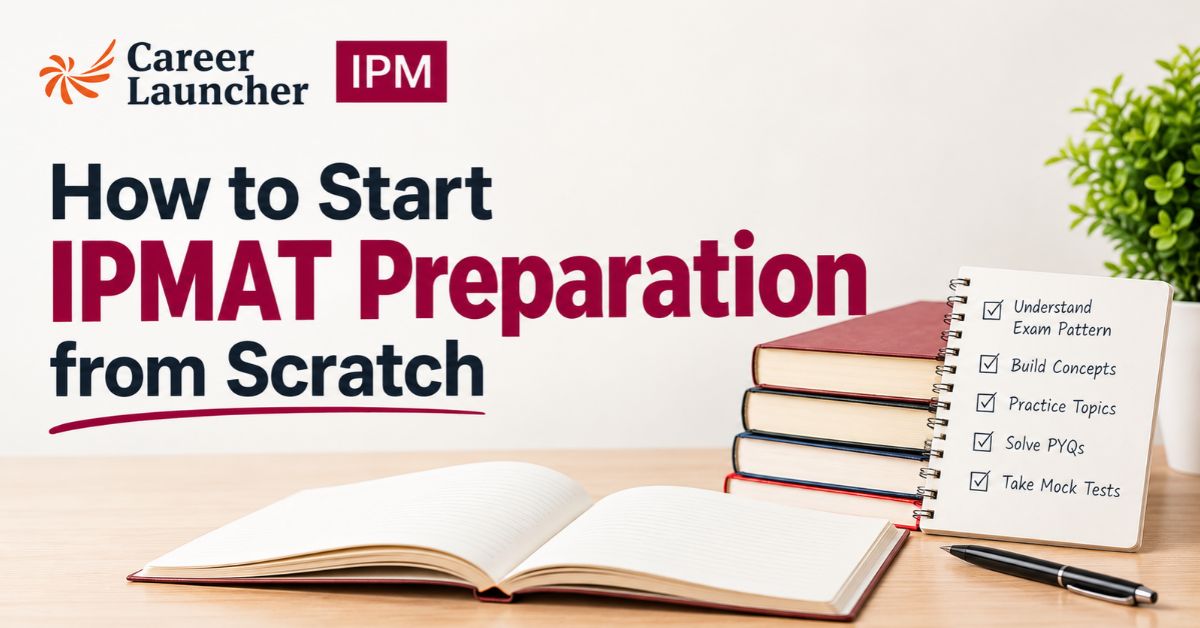
Starting IPMAT preparation from scratch can be confusing when you do not know what to study first. The right approach is to build your preparation step by step instead of trying to cover the entire syllabus at once. Start by understanding the exam, assess your current level, strengthen the basics and gradually move towards practice, PYQs and mock tests.
Table of Contents
How to Start IPMAT Preparation from Scratch
The first step is to understand your target exam. IPMAT exams conducted by different institutes can have different sections, question types and patterns. Therefore, check the latest IPMAT syllabus and exam pattern before creating your study plan.
Next, take a diagnostic test or solve a previous-year paper without preparation. This will help you identify your strengths, weak areas and the topics that need immediate attention.
First Steps Before You Start
- Understand the exam pattern and syllabus.
- Assess your current preparation level.
- Identify strong and weak topics.
- Choose a few reliable study resources.
- Set realistic weekly targets.
- Start with basic concepts before difficult questions.
The goal at this stage is to create a clear direction for your preparation.
Building a Strong Foundation for IPMAT
If you are starting IPMAT preparation from scratch, do not focus on speed immediately. Build strong fundamentals first and gradually increase the difficulty of questions.
For Quantitative Ability, revise basic Mathematics and understand the concepts behind important topics. For Verbal Ability, develop a regular reading habit and work on vocabulary, grammar and comprehension.
A simple preparation cycle is:
Learn the concept → Solve basic questions → Practice → Analyse mistakes → Revise
Once you are comfortable with the basics, you can start working on speed and time management.

What Should I Study First for IPMAT?
Beginners can follow a simple order rather than jumping randomly between topics.
| Priority | Area | Topics to Start With |
| 1 | Arithmetic | Percentages, Ratio, Averages |
| 2 | Arithmetic | Profit & Loss, Time & Work, Time-Speed-Distance |
| 3 | Number System | Divisibility, HCF-LCM, Remainders |
| 4 | Algebra | Equations and basic algebra |
| 5 | Verbal Ability | Reading Comprehension, Vocabulary |
| 6 | Grammar | Basic grammar and sentence structure |
| 7 | Practice | Topic-wise questions and PYQs |
| 8 | Testing | Sectional tests and mocks |
This is only a IPMAT preparation from scratch. You can change the order based on your strengths and weaknesses.
IPMAT Preparation Roadmap for Beginners
A beginner’s preparation can be divided into a few clear stages:
| Stage | What to Do | Focus |
| Assess Your Level | Identify your strengths and weak areas. | Know where to start |
| Build Fundamentals | Strengthen Quant and Verbal basics. | Clear concepts |
| Practice Regularly | Solve topic-wise questions and PYQs. | Accuracy |
| Take Mock Tests | Attempt sectional and full-length tests. | Speed and strategy |
| Analyse & Revise | Review mistakes and revise weak topics. | Improve performance |
If you have more time, spend longer on the foundation and practice stages. If your exam is closer, give greater priority to PYQs, tests and revision.
How to Start IPMAT Quant Preparation
Quantitative Ability can be challenging for beginners, so start with familiar and fundamental topics instead of difficult chapters.
Start With Arithmetic
Begin with:
- Percentages
- Ratio and Proportion
- Averages
- Profit and Loss
- Time and Work
- Time, Speed and Distance
- Simple and Compound Interest
Once you are comfortable with these topics, move to Number System and Algebra. You can then cover areas such as Geometry, Mensuration, Probability and other topics required for your target exam.
Must Read: How to Prepare for IPMAT Quantitative Ability
Follow a Simple Practice Cycle
For every topic, follow:
Concept → Basic Questions → Moderate Questions → PYQs → Timed Practice
Do not rely on shortcuts before understanding the basic method. Accuracy should come first, followed by speed.
How to Start IPMAT Verbal Ability Preparation
Verbal Ability preparation should start from the first day because reading and vocabulary take time to develop.
Read editorials, articles, essays and non-fiction regularly. Along with reading, work on basic grammar and vocabulary before moving to more difficult Reading Comprehension and Verbal Ability questions.
Focus on:
- Daily reading
- Vocabulary through context
- Grammar fundamentals
- Reading Comprehension
- Para jumbles
- Sentence-based questions
As your accuracy improves, start solving passages under a time limit.
Also Read: How to Prepare for IPMAT Verbal Ability
How to Use PYQs for IPMAT Preparation
Do not wait until the end of your preparation to start IPMAT Previous Year Questions. Once you finish a topic, solve its PYQs to understand how the concept is tested.
Initially, solve questions topic-wise. Later, attempt complete papers under timed conditions.
After every PYQ session, identify:
- Questions you got wrong
- Questions you could not attempt
- Questions that took too long
- Concepts that need revision
Maintain an error log and revisit it regularly.
Check Crucial IPMAT Details: IPMAT Indore Section-wise Preparation | IPMAT Indore Section-wise Preparation
When Should Beginners Start IPMAT Mock Tests?
Your first mock can be used as a diagnostic test. However, regular full-length mocks are more useful after you have covered a reasonable portion of the syllabus.
| Stage | Test | Purpose |
| Beginning | Diagnostic test | Assess your level |
| Preparation | Sectional tests | Improve accuracy and speed |
| Later stage | Full-length mocks | Develop exam strategy |
| Final stage | Regular mocks | Build consistency |
Do not focus only on the score. Analyse every mock to understand whether your mistakes came from weak concepts, calculations, time management or incorrect question selection.
Attempt a Free IPMAT Mock Test
Common Mistakes to Avoid
Beginners often make preparation harder by trying to do too much at once. Avoid these common mistakes:
- Starting difficult topics before building basics
- Using too many preparation resources
- Ignoring Verbal Ability
- Delaying PYQs
- Taking mocks without analyzing them
- Skipping revision
- Focusing only on study hours instead of actual progress
Conclusion
If you are starting IPMAT preparation from scratch, focus on building a strong foundation instead of rushing through the syllabus. Give regular time to Quant and Verbal Ability, practice questions topic-wise and introduce PYQs and mocks as your preparation progresses. Keep reviewing your mistakes and revise weak areas regularly. With a structured routine and consistent practice, you can gradually build the skills needed for the exam.
Frequently Asked Questions
How can I start IPMAT preparation from scratch?
Start by understanding the exam pattern, assessing your current level and building basic Quant and Verbal concepts. Then move to topic-wise practice, PYQs and mock tests.
What should I study first for the IPMAT?
Start with basic arithmetic in Quant and reading, vocabulary and grammar in Verbal Ability. Gradually move to other topics as your fundamentals improve.
Is IPMAT difficult for beginners?
IPMAT can be challenging, but beginners can prepare effectively by building strong fundamentals and practicing consistently.
How should I start Quant preparation for the IPMAT?
Begin with arithmetic topics such as percentages, ratios, averages and profit and loss. Then move to Number System, Algebra and other required topics.
How should I start Verbal Ability preparation?
Start with daily reading, vocabulary and grammar. Then gradually introduce Reading Comprehension and other Verbal Ability questions.
How many months are enough for IPMAT preparation?
The required preparation time depends on your starting level, target exam and daily study schedule. More time allows you to spend longer on fundamentals, practice, PYQs, mocks and revision.