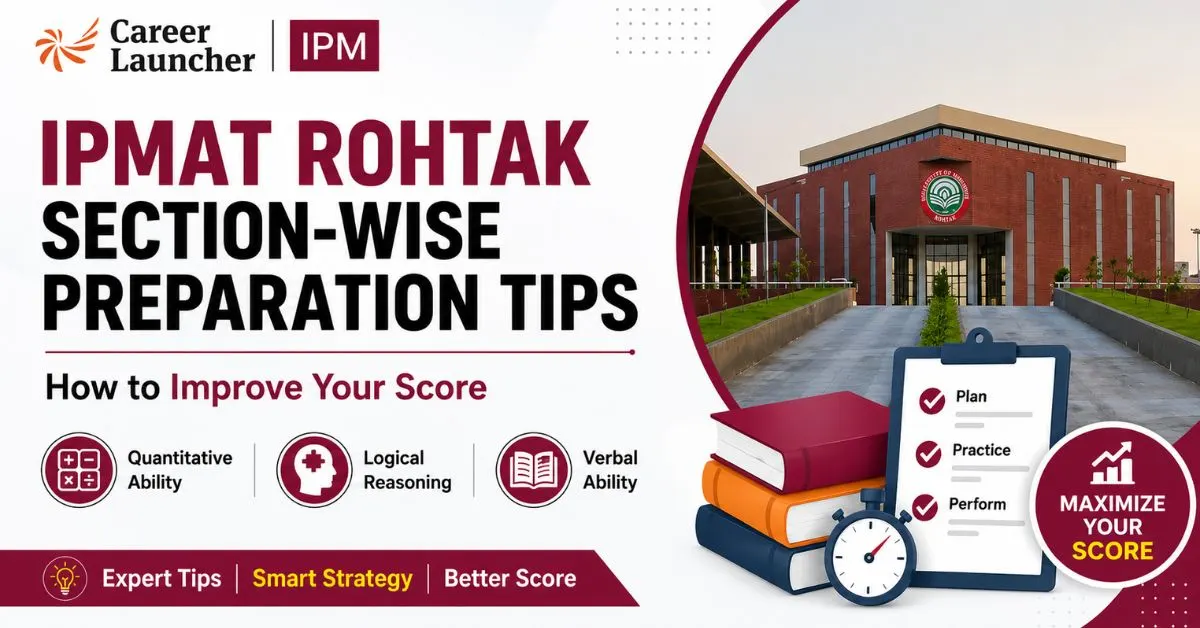
Section-wise Tips to Maximize Your IPMAT Rohtak Score can significantly improve your chances of succeeding in the exam and securing IIM Rohtak IPM admission. Following the right IPMAT Rohtak 2027 section-wise preparation tips enables you to focus on high-weightage topics, strengthen your conceptual understanding, and perform consistently across all sections of the exam.
Since IPMAT Rohtak evaluates candidates on Quantitative Ability, Logical Reasoning, and Verbal Ability, a structured section-wise IPMAT Rohtak preparation strategy is far more effective than studying without a clear plan.
Whether you’re beginning your IPMAT journey or refining your preparation in the final months, understanding the right approach for each section can give you a competitive advantage. Candidates also need a balanced IPMAT Rohtak preparation strategy that emphasizes conceptual clarity, speed, accuracy, and effective time management.
This comprehensive guide shares the best Section-wise Tips to Maximize Your IPMAT Rohtak Score, including expert IPMAT Rohtak section-wise preparation tips for Quantitative Ability, Logical Reasoning, and Verbal Ability. You’ll also learn practical time management strategies and proven preparation techniques to help you perform confidently on exam day.
Table of Contents
IPMAT Rohtak Exam Pattern – Overview
Understanding the IPMAT Rohtak exam pattern is the first step towards effective preparation. Knowing the section-wise structure, marking scheme, and time allocation helps you plan your study schedule and develop an efficient exam strategy.
| Particulars | IPMAT Rohtak |
| IPMAT Rohtak Exam Duration | 120 Minutes |
| Number of Questions in IPMAT Rohtak | 120 (40 questions in each section) |
| Sectional Time Limit | No sectional time limit |
| IPMAT Rohtak Sections | Quantitative Ability, Logical Reasoning, Verbal Ability |
| Question Type | Multiple Choice Questions (MCQs) |
| IPMAT Rohtak Negative Marking | Yes (-1 for every incorrect answer) |
| Difficulty Level | Moderate to High |
| Mathematics Level in IPMAT Rohtak | Primarily Class 10 Mathematics |
Why Is IPMAT Rohtak Different?
Unlike other IPM entrance exams, IPMAT Rohtak includes a dedicated Logical Reasoning section, making analytical thinking an essential part of your preparation. While the mathematics syllabus is comparatively less advanced than IPMAT Indore, the exam demands excellent speed, accuracy, and decision-making skills.
Since every incorrect answer attracts negative marking, candidates should focus on intelligent question selection instead of attempting every question.
IPMAT Rohtak Section-wise Preparation Tips 2027
The IPMAT Rohtak exam is structured around three core sections – Quantitative Ability, Logical Reasoning, and Verbal Ability, to comprehensively assess a candidate’s mathematical, analytical, and language skills. With negative marking for incorrect answers across all three sections, following a customized section-wise IPMAT Rohtak preparation strategy is essential for maximizing your overall score.
IPMAT Rohtak Quantitative Ability Preparation Tips
The Quantitative Ability section in IPMAT Rohtak focuses primarily on arithmetic, algebra, geometry, and data interpretation. The questions are generally application-oriented and require quick calculations rather than advanced mathematical concepts.
Candidates with strong arithmetic fundamentals and good calculation speed often perform well in this section.
IPMAT Rohtak Quantitative Ability High-Weightage Topics
Prioritize the following topics during your preparation:
- Percentages
- Profit & Loss
- Ratio & Proportion
- Average
- Time & Work
- Time, Speed & Distance
- Number System
- Algebra
- Geometry
- Mensuration
- Data Interpretation
- Probability
- Simplification & Approximation
Mastering these topics will help you cover a significant portion of the Quantitative Ability syllabus.
How to Improve IPMAT Rohtak Quantitative Ability Score
- Strengthen Your Arithmetic Fundamentals
Arithmetic forms the backbone of the Quantitative Ability section. Ensure conceptual clarity in:
- Percentages
- Ratios
- Averages
- Profit & Loss
- Time & Work
Once your basics are strong, solving application-based questions becomes much easier.
- Improve Calculation Speed
Quick calculations can save valuable time during the exam. Practice:
- Squares
- Cubes
- Percentage conversions
- Fraction-decimal equivalents
- Multiplication shortcuts
- Mental calculations
Developing these skills can improve both speed and accuracy.
- Practice Topic-wise Questions
Instead of solving random questions, complete one topic thoroughly before moving to the next.
This approach helps reinforce concepts and improves retention.
- Attempt Timed Practice Sets
Solve Quantitative Ability questions under strict time limits to build speed and improve your ability to perform under exam pressure.
- Analyse Every Mock Test
After each mock, identify the following:
- Weak topics
- Frequently repeated mistakes
- Time-consuming question types
- Accuracy percentage
Mock analysis is one of the fastest ways to improve your score.
Also Check: IPMAT Rohtak Quant Syllabus
IPMAT Rohtak Logical Reasoning Preparation Tips
The Logical Reasoning (LR) section is one of the defining features of IPMAT Rohtak and is often considered the highest-scoring section by aspirants. Unlike Quantitative Ability, Logical Reasoning rewards systematic practice, pattern recognition, and analytical thinking rather than mathematical calculations.
Candidates who consistently practice Logical Reasoning can significantly improve both speed and accuracy over time.
Logical Reasoning High-Weightage Topics
Focus on the following topics:
- Seating Arrangement
- Circular Arrangement
- Blood Relations
- Coding-Decoding
- Direction Sense
- Ranking & Ordering
- Syllogisms
- Statement & Conclusion
- Statement & Assumption
- Logical Puzzles
- Calendar
- Clock
- Input-Output
Regular practice of these topics will help you become familiar with recurring question patterns.
How to Improve IPMAT Rohtak Logical Reasoning Score
- Practice Logical Reasoning Every Day
Dedicate at least 45–60 minutes daily to Logical Reasoning practice. Solve:
- Mixed-topic questions
- Seating arrangement sets
- Logical puzzles
- Statement-based reasoning questions
Daily practice improves speed, confidence, and pattern recognition.
- Use Diagrams Wherever Possible
Visual representations make complex questions easier to solve. Draw diagrams for:
- Seating arrangements
- Blood relations
- Direction-based questions
- Family trees
This reduces confusion and minimizes errors.
- Develop a Standard Solving Approach
For every Logical Reasoning question:
- Read the question carefully.
- Identify definite information.
- Draw a rough diagram.
- Place confirmed positions first.
- Use elimination to solve the remaining possibilities.
Following a structured approach reduces solving time and improves accuracy.
- Skip Lengthy Puzzle Sets Initially
Some puzzles consume a disproportionate amount of time.
Finish easier questions first and return to lengthy puzzles if time permits.
- Take Weekly Sectional Tests
Sectional tests help you improve:
- Speed
- Accuracy
- Pattern recognition
- Time management
Analyse every incorrect answer to understand where your reasoning went wrong.
Also Check: IPMAT Rohtak LR Syllabus
IPMAT Rohtak Verbal Ability Preparation Tips
The Verbal Ability (VA) section plays a crucial role in determining your overall IPMAT Rohtak score. Although many aspirants dedicate most of their preparation time to Quantitative Ability and Logical Reasoning, a strong performance in Verbal Ability can significantly improve your overall score and help you comfortably clear the sectional cutoff.
The IPMAT Rohtak syllabus for Verbal Ability includes reading ability, grammar, vocabulary, comprehension, and critical thinking skills. Since the difficulty level is generally moderate, consistent practice can make Verbal Ability one of your highest-scoring sections.
IPMAT Rohtak Verbal Ability High-Weightage Topics
Focus your preparation on the following topics:
- Reading Comprehension
- Grammar
- Vocabulary
- Sentence Correction
- Para Jumbles
- Fill in the Blanks
- Synonyms & Antonyms
- Idioms & Phrases
- Critical Reasoning
- Word Usage
Mastering these topics will improve both your speed and accuracy in the Verbal Ability section.
Also Check: IPMAT Rohtak Verbal Ability Syllabus
Expert Preparation Tips for Verbal Ability
- Develop a Daily Reading Habit
Reading consistently improves your comprehension skills, vocabulary, and reading speed. Spend 30-45 minutes daily reading:
- Newspaper editorials
- Business magazines
- Current affairs articles
- Non-fiction books
- Opinion columns
This habit will also help you tackle inference-based Reading Comprehension questions.
- Practice Reading Comprehension Regularly
Reading Comprehension carries significant weightage in IPMAT Rohtak. Aim to solve:
- 2–3 Reading Comprehension passages daily
- Passages from diverse subjects such as economics, science, psychology, and business
Focus on identifying the author’s tone, central idea, assumptions, and conclusions rather than simply locating facts.
- Strengthen Grammar Fundamentals
Revise important grammar concepts such as:
- Subject–Verb Agreement
- Articles
- Tenses
- Prepositions
- Modifiers
- Parallelism
- Pronouns
A strong grammar foundation improves both accuracy and confidence.
- Learn Vocabulary Through Context
Instead of memorizing long vocabulary lists, learn new words naturally through reading. Maintain a vocabulary notebook that includes:
- New words
- Meanings
- Synonyms
- Usage in sentences
Review it every week for better retention.
- Take Weekly Sectional Tests
Regular Verbal Ability tests help improve:
- Reading speed
- Accuracy
- Time management
- Question selection
Analyse every test to identify recurring mistakes and weak topics.
IPMAT 2026 Question Paper –

IPMAT Rohtak Section-wise Preparation Tips: Common Mistakes to Avoid
Many aspirants lose valuable marks because of avoidable mistakes rather than a lack of preparation. Thoroughly checking the IPMAT 2027 syllabus and identifying these recurring mistakes early can significantly improve your overall performance.
Ignoring Logical Reasoning
Logical Reasoning is one of the highest-scoring sections in IPMAT Rohtak. Neglecting it can reduce your overall score even if your Quantitative Ability is strong.
Guessing Too Many Questions
- Negative marking applies to every section.
- Avoid random guessing unless you can confidently eliminate incorrect options.
Not Taking Enough Mock Tests
Attempting IPMAT Mock tests helps you:
- Build exam temperament
- Improve time management
- Identify weak areas
- Develop an effective exam strategy
Aim to complete 20–30 full-length mock tests before the examination.
Not Analyzing Mock Tests
Simply taking mock tests is not enough. After every mock, analyze:
- Wrong answers
- Time spent per section
- Weak topics
- Easy questions you missed
- Accuracy percentage
Your improvement depends on how well you learn from your mistakes.
Ignoring Revision
Many students continue learning new topics until the last week and neglect revision. Maintain separate notebooks for:
- Formulas
- Vocabulary
- Important concepts
- Mistakes from mock tests
Regular revision improves retention and confidence.
Quick Tips to Maximize Your IPMAT Rohtak Score
- Understand the latest IPMAT Rohtak exam pattern.
- Build strong arithmetic fundamentals.
- Practice Logical Reasoning every day.
- Improve Reading Comprehension through daily reading.
- Solve IPMAT previous year question papers regularly.
- Attempt at least 20–30 mock tests before the exam.
- Analyse every mock test to eliminate recurring mistakes.
- Prioritize accuracy over excessive attempts.
- Revise formulas and vocabulary consistently.
- Develop a personalized exam-day strategy based on your strengths.
What Is the Best Strategy to Improve IPMAT Rohtak 2027 Score?
The best strategy to maximize your IPMAT Rohtak score is to build strong arithmetic fundamentals, practice Logical Reasoning daily, improve Reading Comprehension and grammar, solve full-length IPMAT Rohtak mock tests regularly, and analyze your performance after every test.
Since negative marking applies to all sections, maintaining high accuracy while managing time effectively is the key to achieving a competitive IPMAT Rohtak score.
Conclusion
Cracking IPMAT Rohtak requires more than just hard work—it demands a smart, structured, and section-wise preparation strategy. By following the right IPMAT Rohtak Section-wise Preparation Tips, you can strengthen your Quantitative Ability, improve your Logical Reasoning skills, and consistently enhance your Verbal Ability performance. These Section-wise Tips to Maximize Your IPMAT Rohtak Score, combined with regular mock tests, detailed performance analysis, and disciplined revision, will help you build confidence and improve your chances of securing a competitive score.
Stay consistent, analyze every mock test, and focus on continuous improvement throughout your preparation journey. If you prefer expert guidance and a structured learning approach, enrolling in IPMAT online classes can provide personalized mentorship, comprehensive study material, and exam-oriented practice to help you stay ahead of the competition. With the right strategy and dedicated effort, you can maximize your IPMAT Rohtak score and secure admission to the prestigious Integrated Program in Management (IPM) at IIM Rohtak.
Frequently Asked Questions (FAQs)
- How should I prepare for IPMAT Rohtak?
Follow a structured study plan covering Quantitative Ability, Logical Reasoning, and Verbal Ability. Regular mock tests, previous year papers, and consistent revision are essential for improving your score.
- What is the best strategy to maximize my IPMAT Rohtak score?
The best strategy is to strengthen arithmetic fundamentals, practice Logical Reasoning daily, improve Reading Comprehension, solve mock tests regularly, and maintain high accuracy because every incorrect answer carries negative marking.
- Which section is the most scoring in IPMAT Rohtak?
Logical Reasoning is widely considered one of the highest-scoring sections because consistent practice improves speed, pattern recognition, and accuracy.
- Which topics are important for Logical Reasoning in IPMAT Rohtak?
Focus on Seating Arrangement, Blood Relations, Coding-Decoding, Direction Sense, Ranking, Syllogisms, Statement-Based Reasoning, Logical Puzzles, Calendar, and Clock.
- How many mock tests should I take before IPMAT Rohtak?
You should attempt at least 20–30 full-length mock tests, along with sectional tests, before appearing for the examination.
- How can I improve my Verbal Ability score?
Read newspapers and editorials daily, practice Reading Comprehension regularly, strengthen grammar concepts, improve vocabulary in context, and solve sectional tests every week.
- Is IPMAT Rohtak easier than IPMAT Indore?
IPMAT Rohtak is generally considered less mathematics-intensive than IPMAT Indore. However, it demands excellent speed, Logical Reasoning skills, and accuracy due to negative marking.
- Should I attempt every question in IPMAT Rohtak?
No. Since negative marking applies to all sections, attempt only those questions where you are reasonably confident or can eliminate incorrect options.
- What are the common mistakes students make during IPMAT Rohtak preparation?
Common mistakes include ignoring Logical Reasoning, avoiding mock tests, guessing too many answers, neglecting revision, and failing to analyze mock test performance.
- Can I crack IPMAT Rohtak without coaching?
Yes. A disciplined preparation strategy, regular practice, mock tests, previous year papers, and consistent revision are sufficient for many aspirants to crack IPMAT Rohtak through self-study.