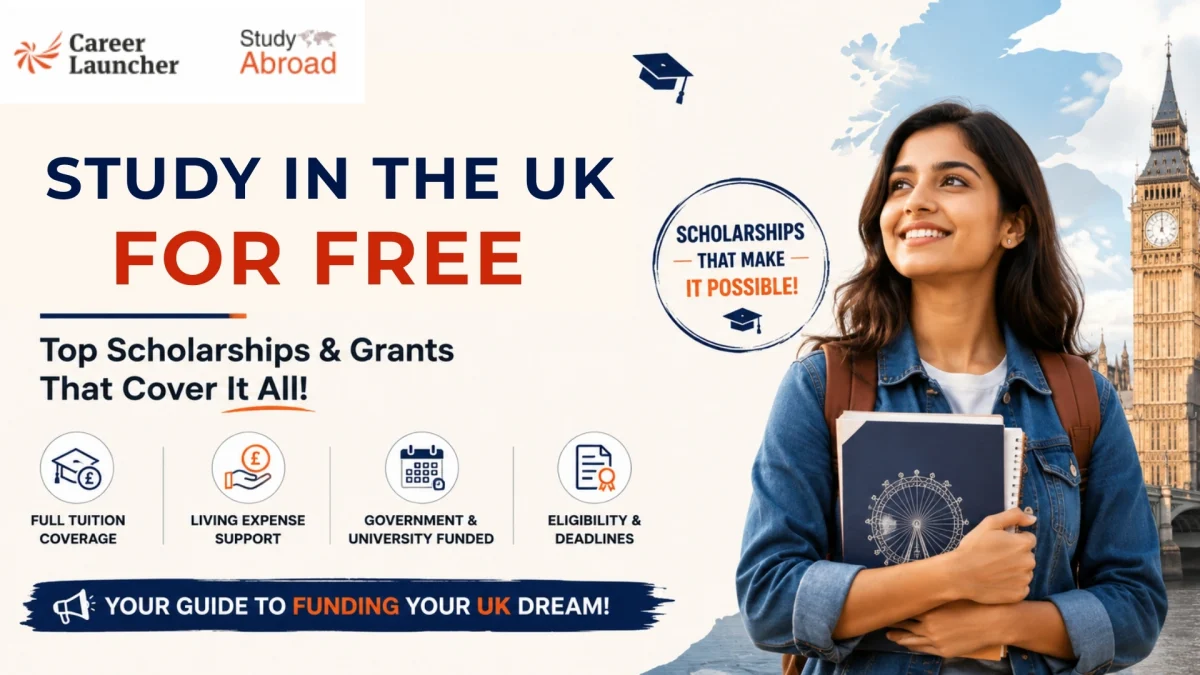
Studying in the UK for free is possible, but it rarely means walking into a university with no funding at all. It means securing a scholarship, grant, or fee waiver that covers tuition, living costs, or both, so a UK degree costs little to nothing out of pocket. With postgraduate tuition at UK universities typically running between £15,000 and £30,000 a year for international students, plus living expenses, fully-funded routes like the Chevening, Commonwealth, and Clarendon scholarships are the realistic path to a debt-free UK education.
This guide covers every legitimate route: government-funded scholarships, university-specific full-rides, GREAT Scholarships for Indian applicants, and how part-time work under a UK Student visa can offset any remaining costs. Each section includes eligibility, coverage, and deadlines, so you can build an application strategy around the scholarships you actually qualify for, rather than chasing schemes that do not apply to your profile.
Table of Contents
What Does “Studying in the UK for Free” Actually Mean?
“Studying in the UK for free” means enrolling in a UK degree programme where a scholarship, bursary, or government-funded award covers your tuition fees, living expenses, or both, so you pay little to nothing directly. It is not an informal concession; every route below requires meeting strict eligibility criteria and competing against thousands of other applicants. The main categories are:
- Government-funded scholarships, such as Chevening, Commonwealth, and GREAT Scholarships
- University-funded scholarships, such as Oxford’s Clarendon Scholarship and similar schemes at Cambridge, LSE, and other institutions
- Fee waivers and need-based bursaries offered directly by individual UK universities
- Part-time work under a Student visa, which offsets living costs but does not fund tuition
The rest of this guide walks through each of these in detail, starting with the most prestigious government-funded option. If you are only just starting to map out the wider process, from shortlisting courses to visas, our UK study guide is a useful starting point before narrowing in on funding.
Fully Funded Government Scholarships to Study in the UK for Free
There are numerous fully funded government scholarships to study in the UK for international students, including the Chevening Scholarship, the GREAT Scholarship, and Commonwealth Scholarships. Each of these operates differently in terms of coverage, eligibility, and the kind of applicant it is designed for, so it helps to treat them as three separate strategies rather than one shared category. Find out more about them in detail below.
Chevening Scholarship
Chevening is the UK government’s flagship scholarship, funded by the FCDO and its partner organisations. It funds one-year taught master’s degrees at any UK university, and is aimed at emerging leaders rather than pure academic achievers.
Coverage: Tuition fees (capped at £22,000 for MBA programmes), a monthly stipend, economy-class return airfare, an arrival allowance, a homeward departure allowance, the cost of one visa application, and a travel grant to attend Chevening events in the UK.
Eligibility: You must be a citizen of a Chevening-eligible country, hold an undergraduate degree that qualifies you for a UK master’s, have at least 2,800 hours of work experience gained after graduating, apply to three different eligible UK master’s courses and secure an unconditional offer from at least one, and commit to returning to your home country for a minimum of two years after the scholarship ends.
Deadline: Applications typically open in early August and close in early October, with interviews in the following spring and results by June, ahead of a September or October start.
Commonwealth Master’s Scholarship
Also funded by the FCDO but administered by the Commonwealth Scholarship Commission (CSC), this scholarship targets students from low- and middle-income Commonwealth countries, including India, who could not otherwise afford to study in the UK.
Coverage: Full tuition fees, approved return airfare, a monthly stipend of £1,452 outside London or £1,781 within the London metropolitan area for the 2026-27 academic year, a warm clothing allowance, a study travel grant, and a child allowance for scholars with dependants.
Eligibility: You must be a citizen of, or hold refugee status in, an eligible Commonwealth country; hold at least an upper second-class (2:1) honours degree, or a lower second with a relevant postgraduate qualification; and demonstrate that you genuinely cannot afford UK study without this funding. Indian applicants apply through both the CSC Central portal and the Ministry of Education’s SAKSHAT portal.
Deadline: The CSC portal typically closes in mid-October, with nominating agencies submitting shortlists by December and results announced by July, ahead of a September start.
GREAT Scholarships
The GREAT Scholarships programme is a partnership between the UK government’s GREAT Britain Campaign, the British Council, and individual UK universities. Unlike Chevening or Commonwealth awards, it is a partial scholarship rather than a full ride, but it is one of the more accessible routes for Indian postgraduate applicants.
Coverage: A minimum of £10,000 towards tuition fees for a one-year taught postgraduate course.
Eligibility and participating universities: For the 2026-27 academic year, 12 scholarships are available to Indian students across Anglia Ruskin University, Norwich University of the Arts, Queen’s University Belfast, the Royal College of Art, the Royal Conservatoire of Scotland, the Royal Northern College of Music, the University of Bristol, Trinity Laban Conservatoire of Music and Dance, the University of Dundee, the University of Reading, the University of Surrey, and UWE Bristol. Applicants must be Indian citizens and residents, hold a relevant undergraduate degree, and meet the English language requirements of their chosen university.
Deadline: Each participating university sets its own deadline, so applicants must apply for both the course and the scholarship directly through the individual university’s scholarship page.

University-Funded Full Scholarships
Clarendon Scholarship (University of Oxford)
Established in 2001 and funded primarily by Oxford University Press, the Clarendon Fund awards over 200 fully-funded scholarships every year to graduate applicants across all academic divisions, with no restriction on nationality or field of study.
Coverage: Full tuition and college fees for the entire period of fee liability, plus an annual grant for living expenses, for both full-time and part-time master’s and DPhil students.
How to apply: There is no separate application. Every applicant to a graduate course at Oxford who applies by the relevant December or January course deadline is automatically considered for a Clarendon award based on academic merit and potential.
Other University-Run Scholarships
Cambridge, LSE, Imperial College London, UCL, and most other major UK universities run their own fully or partially funded scholarships for international master’s and PhD students. These typically cover tuition and a living stipend and are awarded either automatically alongside a course application or through a short supplementary form. Because coverage, value, and deadlines vary significantly between institutions and change year to year, it is worth cross-checking our detailed roundup of top UK university scholarships for Indian students alongside each university’s official funding page before applying.
Fully Funded UK Scholarships: Quick Comparison
| Scholarship | Funded By | Study Level | What It Covers | Typical Deadline |
| Chevening Scholarship | UK Foreign, Commonwealth & Development Office (FCDO) | Master’s (1 year) | Tuition, monthly stipend, return airfare, arrival/departure allowance, visa cost | Early August to early October |
| Commonwealth Master’s Scholarship | FCDO, administered by the Commonwealth Scholarship Commission (CSC) | Master’s (1 year) | Full tuition, approved airfare, monthly stipend, warm clothing allowance, study travel grant | Mid-October |
| GREAT Scholarships | UK GREAT Britain Campaign, British Council, and partner universities | Master’s (1 year, taught) | Minimum £10,000 towards tuition fees (partial award) | Varies by university |
| Clarendon Scholarship | University of Oxford (Oxford University Press) | Master’s and DPhil | Full tuition and college fees, plus an annual living expenses grant | December or January (course-dependent) |
Confused About Which UK Scholarship Fits Your Profile?
Get a personalised scholarship shortlist based on your academic profile, preferred universities, and career goals. Career Launcher Study Abroad experts will help you identify the best funding opportunities and strengthen your scholarship applications.
How to Cover the Rest: Part-Time Work Rules on a Student Visa
Even with a full scholarship, most students budget for incidental costs. A UK Student visa permits limited part-time work, which can help, though it is not a substitute for tuition funding.
- 20 hours a week during term time for students on a degree-level course, and full-time during official university vacations
- The weekly cap runs Monday to Sunday and cannot be averaged across weeks; working 25 hours one week and 15 the next is still a visa breach
- From April 2026, the National Living Wage is £12.71 an hour for workers aged 21 and over, and the National Minimum Wage is £10.85 an hour for those aged 18 to 20
- Self-employment, freelancing, and professional sport or entertainment work are prohibited on a Student visa
- After completing your course, the Graduate Route visa removes all hour and role restrictions, making it the main bridge into full-time UK employment
Visa Financial Requirements to Keep in Mind
Even scholarship holders must show UKVI that maintenance funds and any unpaid tuition balance are covered when applying for a Student visa. For the 2026-27 academic year, the required maintenance funds are £1,529 per month (up to £13,761) for study in London, and £1,171 per month (up to £10,539) outside London, for a maximum of nine months. If your scholarship pays the stipend directly or covers fees in full, keep the official award letter on hand, as it forms part of your visa evidence. For a detailed breakdown, see our guide on UK student visa financial requirements.
How to Build Your Study Application Strategy
Turning any of the scholarships above into an actual offer takes a sequenced plan rather than a single application submitted close to a deadline. The six steps below outline roughly the order in which shortlisting, essays, offers, and visa paperwork typically fall into place.
- Shortlist three to five UK universities and courses that match your academic profile and career goals, starting 12 to 18 months before your intended intake. Our UK university rankings guide can help you build a balanced list.
- Check each scholarship’s specific eligibility criteria before applying. Chevening and Commonwealth require separate applications; Clarendon and most university-run awards are automatic once you apply for the course.
- Draft a strong personal statement and scholarship essays tailored to each funder’s priorities. See our guide on how to write a UK scholarship essay for a structure that works.
- Secure your unconditional university offer(s) well before each scholarship’s deadline, since most awards require this as a prerequisite. Track key dates using our UK application deadlines calendar.
- Submit your Student visa application with proof of remaining funds, if any, and your scholarship award letter. Our UK student visa guide walks through the full process.
- Once you arrive, budget for day-to-day costs and consider part-time work within your visa limits. Our guides on cost of living in the UK and best part-time jobs in the UK for Indian students can help you plan ahead.
Key Takeaways
- Chevening, Commonwealth, and Clarendon scholarships offer genuinely full funding, covering tuition and living costs, but all three are highly competitive
- GREAT Scholarships offer a partial but valuable tuition reduction with a simpler, university-direct application process
- Government scholarship deadlines fall between August and mid-October for a start the following autumn, so preparation should begin 12 to 18 months in advance
- Even fully-funded scholars must still meet UKVI’s visa maintenance fund requirements unless the scholarship letter explicitly confirms full financial coverage
- Part-time work under a Student visa can offset incidental costs but is capped at 20 hours a week during term time and cannot replace tuition funding
Recommended Reads
FAQs
What is the easiest way to study in the UK for free?
For most Indian applicants, GREAT Scholarships are the most accessible starting point since they only require applying directly to a participating university, with no separate multi-stage selection process. For a genuinely full ride covering tuition and living costs, Chevening, Commonwealth, and Clarendon are the strongest options, though they are far more competitive.
Can Indian students study in the UK completely free?
Yes, through fully-funded awards such as Chevening, the Commonwealth Master’s Scholarship, or Oxford’s Clarendon Scholarship, all of which cover full tuition plus a living stipend for eligible Indian applicants. These are highly competitive and require strong academics, a clear personal statement, and, for Chevening, relevant work experience.
Which scholarship covers 100% of UK study costs?
Chevening, the Commonwealth Master’s Scholarship, and Oxford’s Clarendon Scholarship all cover full tuition plus a living allowance. GREAT Scholarships, by contrast, only cover a minimum of £10,000 towards tuition and do not include living costs.
When should Indian students apply for the Chevening Scholarship?
Applications typically open in early August and close in early October for a September or October start the following year. Start preparing your essays, references, and university shortlist at least three to four months before the deadline.
Do I need work experience to apply for Chevening?
Yes. Chevening requires at least 2,800 hours of work experience gained after completing your undergraduate degree, equivalent to roughly two years of full-time work. This can combine full-time, part-time, voluntary, and internship experience across multiple roles.
Can I work part-time while on a scholarship in the UK?
Yes. A scholarship does not affect your Student visa work rights. You can still work up to 20 hours a week during term time and full-time during official vacations, subject to the same visa conditions as any other international student.
What grade do I need for the Commonwealth Master’s Scholarship?
You need at least an upper second-class (2:1) honours degree, or a lower second-class degree combined with a relevant postgraduate qualification. You must also demonstrate that you genuinely cannot afford UK study without this funding.
Are GREAT Scholarships enough to study in the UK for free?
On their own, no. GREAT Scholarships provide a minimum of £10,000 towards tuition, which is a meaningful reduction but rarely the full fee for a postgraduate course. Most recipients combine it with savings, a student loan, or part-time work to cover the remaining tuition and living costs.