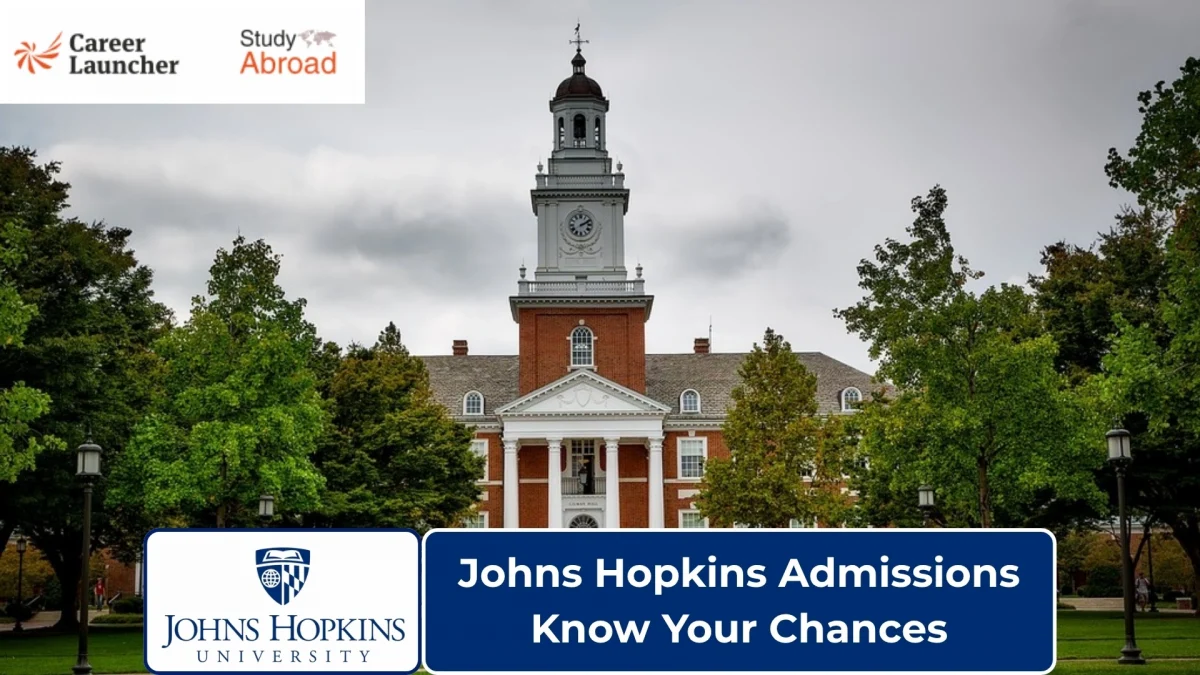
Johns Hopkins University’s acceptance rate fell to a record-low 5.14% for the Class of 2029, making it one of the most selective universities in the United States and, by raw admit rate, more competitive than several Ivy League schools. Out of 49,112 applications, only 2,525 students received an offer, continuing a decade-long trend of rising applications and shrinking admit numbers driven by test-optional policies and JHU’s growing reputation in STEM, pre-med, and public health.
This guide breaks down Johns Hopkins’ overall, Early Decision, and Regular Decision acceptance rates, how the numbers have shifted over the past several admissions cycles, what an admitted student’s academic profile typically looks like, and how the university’s new tuition-free program changes the cost calculation for most American families. Whether you are building your college list or finalising your application strategy, the data here reflects the most recently released Common Data Set and official Johns Hopkins admissions figures.
Table of Contents
What Is Johns Hopkins’ Acceptance Rate?
Johns Hopkins University’s acceptance rate is the percentage of applicants offered admission out of the total number who applied in a given cycle. For the Class of 2029, this stood at 5.14%, based on 2,525 admits from 49,112 applications, making it one of the lowest acceptance rates of any research university in the country.
(Source: https://apply.jhu.edu/fast-facts/ )
Johns Hopkins Acceptance Rate by the Numbers
Johns Hopkins’ selectivity has transformed dramatically over the past decade. Applications rose from roughly 26,600 for the Class of 2021 to 49,112 for the Class of 2029, an 85% increase, while the number of admitted students fell over the same period. The table below tracks the overall trend using JHU’s Common Data Set and official admissions announcements.
| Entering Class | Applications | Admitted | Acceptance Rate |
| Class of 2022 | 29,128 (approx.) | 3,446 | 11.83% |
| Class of 2025 | ~38,700 | ~3,100 | ~8% |
| Class of 2028 | 45,895 | 2,954 | 6.44% |
| Class of 2029 | 49,112 | 2,525 | 5.14% |
For the Class of 2030 (entering fall 2026), Johns Hopkins has admitted 2,795 students in total: 553 through Early Decision I in December 2025, 260 through Early Decision II in February 2026, and 1,982 through Regular Decision in March 2026. The university has not yet released the total application count for this cycle, so a final acceptance rate is not yet available, though the trend points to a rate at or below 5%.
Want to be among the top 5% at John Hopkins?
Get expert support for application strategy, essays, recommendations, test preparation, and visa guidance.

Early Decision vs. Regular Decision Acceptance Rates
Applying Early Decision at Johns Hopkins roughly doubles an applicant’s odds compared with Regular Decision, though the gap has narrowed sharply as ED applications have surged.
| Round (Class of 2029) | Applications | Admitted | Acceptance Rate |
| Early Decision (I + II combined) | 7,563 | 793 | 10.49% |
| Regular Decision | 41,549 | 1,732 | 4.17% |
| Overall (ED + RD) | 49,112 | 2,525 | 5.14% |
Johns Hopkins offers two Early Decision rounds: ED I, due November 1, with decisions released in mid-December, and ED II, due January 2, with decisions released in mid-February. Regular Decision applications are also due January 2, with decisions announced in late March. ED applications have nearly quadrupled since the Class of 2021, climbing from 1,934 to 7,563 for the Class of 2029, while the number of ED admits has stayed relatively stable, pushing the ED acceptance rate down from around 31% for the Class of 2023 to 10.49% for the Class of 2029.
How Johns Hopkins Compares to Other Selective Universities
Johns Hopkins’ roughly 5% acceptance rate now places it in similar territory to several Ivy League schools. For the Class of 2029, Cornell admitted around 8.38% of applicants, Brown around 5.65%, and Penn around 4.9%, making Johns Hopkins statistically more selective than Cornell and Brown and comparable to Penn.
If you are comparing Johns Hopkins against other reach schools, our guides on the Harvard acceptance rate for the Class of 2029, the NYU acceptance rate for the Class of 2029, and the Oxford University acceptance rate break down the same data for other top-choice schools.
What It Takes to Get Into Johns Hopkins
Academic Profile of Admitted Students
- Average unweighted GPA of admitted students: 3.93, with 65% holding a 4.0 GPA
- Middle 50% SAT range for recently enrolled students: 1530 to 1560
- Middle 50% ACT range for recently enrolled students: 34 to 36
- 100% of enrolled students placed in the top decile of their graduating high school class
- For the Class of 2029, 61% of admits attended public high school and 39% attended private or independent schools
What Johns Hopkins Looks for Beyond Test Scores
Johns Hopkins uses holistic review, weighing intellectual curiosity, research experience, and community engagement alongside academics. Following the 2023 US Supreme Court decision restricting race-conscious admissions, the university can no longer use race as a formal admissions factor, but continues to consider how an applicant’s background and lived experience shaped their character through essays and personal context.
- 87 to 92% of recent admits held a part-time job, internship, or summer job during high school
- Just under half of admits were involved in advocacy, policy, or civic engagement work
- 21% of the Class of 2029 identify as first-generation college students
- The admitted Class of 2029 includes students from 42 US states and 39 countries, with international students making up 13.5% of the enrolled class
Affording Johns Hopkins: The New Tuition Promise
Cost is a major factor for many applicants weighing Johns Hopkins against other reach schools, and the university’s financial aid policy changed significantly for the 2026-2027 academic year. Starting this cycle, Johns Hopkins is tuition-free for all undergraduates from families earning up to $200,000 a year, covering an estimated 85% of American households.
- Families earning up to $200,000: Tuition is fully covered; families are typically responsible for housing, dining, and personal expenses
- Families earning up to $100,000: Tuition, fees, housing, dining, and most personal expenses are covered, for a $0 parent contribution
- Families earning above $200,000: Johns Hopkins continues to meet 100% of demonstrated financial need, and most families earning up to $250,000 still qualify for significant aid
This policy builds on Johns Hopkins’ 2018 shift to permanently need-blind, no-loan admissions following a $1.8 billion gift from alumnus Michael Bloomberg. All applicants seeking aid must submit the CSS Profile, and US citizens and eligible non-citizens must also file the FAFSA.
How to Improve Your Chances of Admission
- Apply Early Decision if Johns Hopkins is genuinely your first choice, since the ED acceptance rate is roughly double the Regular Decision rate, though it is a binding commitment.
- Build a balanced college list rather than relying on a single reach school. Our guide on building a balanced university list explains how to structure reach, match, and safety options.
- Write supplemental essays that name specific labs, programs, or faculty and connect them to a genuine intellectual interest rather than generic praise for the university’s ranking. Our college admission essay guide covers structure and common mistakes.
- Demonstrate sustained, not sudden, engagement in the activities you list, since Johns Hopkins’ holistic review rewards depth over a long list of one-off achievements.
- Understand the full US application process end to end before you begin, especially if you are applying from outside the United States. Our step-by-step guide to UG admissions in the US walks through standardised tests, recommendation letters, and deadlines.
Key Takeaways
- Johns Hopkins’ overall acceptance rate hit a record low of 5.14% for the Class of 2029, down from 11.83% for the Class of 2022
- Early Decision applicants had roughly double the acceptance rate of Regular Decision applicants for the Class of 2029: 10.49% versus 4.17%
- Applications grew 85% between the Class of 2021 and the Class of 2029, while admit numbers fell, driving the sharp rise in selectivity
- Starting with the 2026-2027 academic year, Johns Hopkins is tuition-free for families earning up to $200,000, and fully covers costs for families earning up to $100,000
- Class of 2030 admit numbers are confirmed at 2,795, but the application total and final acceptance rate have not yet been released
Recommended Reads
- Harvard Acceptance Rate: Class of 2029
- NYU Acceptance Rate: Class of 2029
- Oxford University Acceptance Rate 2026
- Step-by-Step Guide for UG Admissions in the US
FAQs
What is Johns Hopkins University’s acceptance rate?
Johns Hopkins’ acceptance rate for the Class of 2029 was 5.14%, based on 2,525 students admitted out of 49,112 applicants, the lowest in the university’s history.
Is Johns Hopkins harder to get into than Ivy League schools?
For the Class of 2029, Johns Hopkins’ 5.14% acceptance rate was lower than Cornell’s (around 8.38%) and Brown’s (around 5.65%), and close to Penn’s (around 4.9%), meaning it is now comparably or more selective than several Ivy League schools, even though it is not formally part of the Ivy League.
Does applying Early Decision improve your chances at Johns Hopkins?
Yes. The combined Early Decision acceptance rate for the Class of 2029 was 10.49%, roughly double the 4.17% Regular Decision rate. ED is a binding commitment, so it should only be used for a genuine first-choice school.
What GPA and test scores does Johns Hopkins expect?
Recently enrolled classes averaged a 3.93 GPA, with 65% holding a 4.0. The middle 50% SAT range was 1530 to 1560, and the middle 50% ACT range was 34 to 36, though Johns Hopkins reviews applications holistically alongside these numbers.
Is Johns Hopkins need-blind for undergraduate admissions?
Yes. Johns Hopkins has been permanently need-blind and need-no-loan since a 2018 gift from alumnus Michael Bloomberg, meaning financial need is not considered during the admissions decision.
Can I attend Johns Hopkins for free?
Starting with the 2026-2027 academic year, Johns Hopkins is tuition-free for undergraduates from families earning up to $200,000 a year and covers tuition, fees, housing, and dining for families earning up to $100,000 a year. Families above these thresholds may still qualify for substantial need-based aid.
How many students applied to Johns Hopkins for the Class of 2030?
Johns Hopkins has not yet released the total application count for the Class of 2030. It has confirmed 2,795 total admits across Early Decision I, Early Decision II, and Regular Decision, so the final acceptance rate is not yet available.
What does Johns Hopkins look for in applicants beyond grades and test scores?
Johns Hopkins uses holistic review, prioritising intellectual curiosity, research experience, and community engagement. Since a 2023 US Supreme Court ruling, race can no longer be a formal admissions factor, though applicants may still discuss how their background shaped their character and perspective.