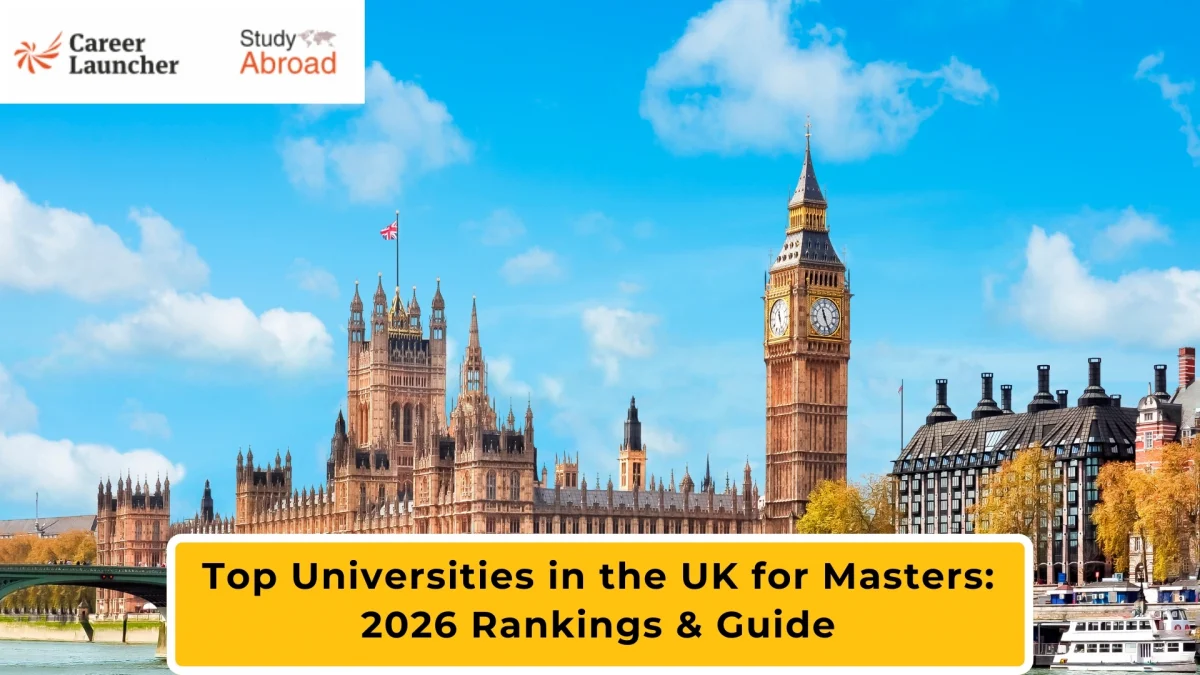
The UK is one of the world’s most sought-after destinations for postgraduate study, and with good reason. Four UK universities rank in the global QS top 10, more than any country except the United States. A UK master’s is almost always one year long, which means lower overall cost, less time away from the workforce, and a degree that global employers recognise and respect.
This guide covers the top universities to study in the UK for a master’s in 2026, ranked by QS World University Rankings 2026, with specific information on tuition fees, popular programmes, entry requirements, and post-study work options.
Table of Contents
Why Choose the UK for a Master’s Degree?
Before comparing universities, it helps to understand what makes the UK a strong postgraduate destination for international students.
- One-year taught master’s: Most UK master’s programmes take 12 months full-time, compared to two years in the US or Australia. You pay one year of fees and living costs, and re-enter the job market faster.
- Global recognition: UK degrees are widely accepted by employers and governments worldwide. The Russell Group, a coalition of 24 leading research universities, is among the most respected higher education consortiums globally.
- Post-study work rights: International graduates can stay and work in the UK under the Graduate Route Visa without needing a job offer in advance. Note that from 1 January 2027, the duration for bachelor’s and master’s graduates reduces from two years to 18 months. PhD graduates retain three years. Students who complete their degree and apply before 31 December 2026 are still eligible for the two-year route.
- Diverse student community: The UK hosts over 600,000 international students. Top universities like UCL and Imperial typically have 40-60% international student populations.
- Scholarship availability: From the UK government’s Chevening Scholarship to university-specific awards, funding options for international students are significant. Read our guide to top UK scholarships for a full breakdown.
For a full picture of student life, read our complete UK study guide before finalising your university list.
QS World University Rankings 2026: Top UK Universities at a Glance
The QS World University Rankings 2026 are the primary global benchmark used by students, universities, and employers. They assess institutions on academic reputation, employer reputation, faculty-to-student ratio, research citations, international outlook, and sustainability.
Here is the full list of UK universities ranked in the global top 100 (QS 2026):
| QS Global Rank | University | Location | Overall Score |
| #2 | Imperial College London | London | 99.4 |
| #4 | University of Oxford | Oxford | 99.8 (Academic Rep) |
| #6 | University of Cambridge | Cambridge | Top 10 Consistent |
| #9 | UCL (University College London) | London | Top 10 |
| #31 | King’s College London (KCL) | London | Top 50 |
| #34 | University of Edinburgh | Edinburgh | Top 50 |
| #35 | University of Manchester | Manchester | Top 50 |
| #51 | University of Bristol | Bristol | Top 100 |
| #56 | LSE (London School of Economics) | London | Top 100 |
| #74 | University of Warwick | Coventry | Top 100 |
Note: 17 UK universities feature in the global top 100, and 24 Russell Group institutions rank within the top 200 globally.
Need help choosing the right UK university for your master’s?Career Launcher’s Study Abroad experts can help you shortlist universities based on your academic profile, career goals, budget, and preferred course. We’ll also guide you through applications, scholarships, SOPs, and visa planning.
|

Top Universities in UK for Masters: In-Depth Profiles
1. Imperial College London (QS #2)
Imperial is the highest-ranked university in the UK and the second-highest in the world as of 2026. It is a specialist institution covering science, engineering, medicine, and business exclusively. Its strength in research citations and employer reputation is exceptional: it scores a perfect 100 out of 100 for employer reputation in QS 2026.
Best suited for: MSc programmes in Artificial Intelligence, Biomedical Engineering, Advanced Computing, Chemical Engineering, Finance, and Data Science.
Tuition fees: Typically GBP 32,000 to GBP 40,000 per year for international students, depending on the course.
Entry requirements: Strong first-class or upper second-class bachelor’s degree (or equivalent). Most programmes require IELTS 6.5 to 7.0 overall, with no band below 6.0.
Notable feature: Imperial’s strong industry links mean postgraduate students get access to placement opportunities with FTSE 100 firms, global tech companies, and pharmaceutical leaders.
2. University of Oxford (QS #4)
Oxford scores a perfect 100 for academic reputation in QS 2026 and is among the most internationally recognised institutions in the world. Founded in the 12th century, Oxford comprises 36 colleges and accepts postgraduate students across virtually every discipline.
Best suited for: MBA (Said Business School), MSc in Computer Science, MSc in Financial Economics, MPhil in Development Studies, MSc in Biodiversity, Conservation, and Management.
Tuition fees: Typically GBP 26,000 to GBP 62,820 per year for international postgraduate students (2026/27 published rates), with clinical and professional courses at the higher end.
Entry requirements: Strong undergraduate record from a recognised institution. Shortlisted candidates are generally invited for an interview. Most programmes require IELTS 7.0 or above.
Notable feature: Oxford’s tutorial system provides one-to-one or small group teaching, rare at the postgraduate level. The Saïd Business School’s MBA is ranked in the global top 20.
See our blog on Oxford University acceptance rate 2026 for more on admissions selectivity.
3. University of Cambridge (QS #6)
Cambridge is the third-highest ranked UK university and one of the most respected research institutions globally. Founded in 1209, it has produced 121 Nobel Laureates and counts Isaac Newton, Alan Turing, and Stephen Hawking among its alumni. Cambridge is organised into 31 colleges.
Best suited for: MPhil in Advanced Computer Science, MBA (Judge Business School), Master of Law (LLM), MPhil in Physics, MRes in Biotechnology.
Tuition fees: Typically GBP 24,000 to GBP 55,000 per year for international students.
Entry requirements: First-class or equivalent undergraduate degree from a recognised university. IELTS score of 7.5 overall for most programmes, with high component minimums.
Notable feature: Cambridge offers the Gates Cambridge Scholarship, one of the most prestigious postgraduate awards in the world, covering full costs for outstanding international students.
4. UCL – University College London (QS #9)
UCL is the broadest of the top-ranked London universities, with strengths spanning architecture (the Bartlett School), neuroscience, economics, law, engineering, and the humanities. It was the first English university to admit students regardless of religion and the first to admit women on equal terms. UCL consistently sits in the global top 10.
Best suited for: MSc in Data Science, MSc in Urban Studies, LLM, MSc in Economics, MSc in Neuroscience, MA in Creative Arts.
Tuition fees: Typically GBP 20,000 to GBP 35,000 per year for international postgraduate students.
Entry requirements: Upper second-class degree equivalent or above. IELTS 6.5 to 7.5 depending on the programme.
Notable feature: UCL’s location in Bloomsbury puts students in the heart of London, close to major research institutions, museums, and employers. Its alumni include Mahatma Gandhi and Christopher Nolan.
5. King’s College London (QS #31)
King’s is one of England’s oldest universities, founded in 1829, and is spread across landmark Thames-side campuses in central London. It is globally ranked for law, medicine, psychiatry, dental sciences, nursing, and war studies.
Best suited for: LLM, MSc in Global Health, MA in War Studies, MSc in Mental Health Studies, MA in International Relations.
Tuition fees: Typically GBP 22,000 to GBP 32,000 per year for international postgraduate students.
Entry requirements: Upper second-class degree or international equivalent. IELTS 7.0 or above for most programmes.
Notable feature: King’s Department of War Studies is the oldest and one of the most prestigious of its kind in the world. King’s also has strong NHS connections, making it particularly strong for healthcare-related masters.
If you are planning to study medicine or healthcare in the UK, read our guide on how the NHS works for Indian students.
6. University of Edinburgh (QS #34)
Edinburgh is Scotland’s oldest university and one of the UK’s leading research institutions. It consistently ranks among the top 40 globally, and its beautiful Old Town campus and vibrant student culture make it a highly popular choice for international students.
Best suited for: MSc in Artificial Intelligence, MSc in Data Science, MBA (Business School), MSc in Global Environment and Climate Change, LLM.
Tuition fees: Typically GBP 22,000 to GBP 36,000 per year for international students.
Entry requirements: Strong undergraduate degree in a relevant subject. IELTS 6.5 to 7.0.
Notable feature: Edinburgh is one of the top UK universities for AI and machine learning research, and has strong links with leading technology companies.
7. University of Manchester (QS #35)
Manchester is one of the UK’s largest universities and the founding home of the Russell Group. It is renowned for research in physics, chemistry, materials science, economics, and social sciences. Manchester consistently attracts one of the highest numbers of international students in the UK.
Best suited for: MSc in Finance, MSc in Data Science, MBA, MSc in Advanced Computer Science, MA in International Development.
Tuition fees: Typically GBP 19,000 to GBP 28,000 per year for international postgraduate students.
Entry requirements: 2:1 equivalent undergraduate degree. IELTS 6.5 overall with no band below 6.0.
Notable feature: Manchester has produced 25 Nobel Laureates and is closely linked with the city’s thriving technology and financial services sectors, offering excellent networking and placement opportunities.
8. University of Bristol (QS #51)
Bristol is one of the UK’s most popular universities and has been rising steadily in global rankings, reaching #51 in QS 2026. It is recognised for engineering, law, medicine, education, and social sciences, and offers a close-knit campus experience in one of the UK’s most vibrant cities.
Best suited for: MSc in Robotics, MSc in Machine Learning, LLM, MSc in International Law, MSc in Environmental Policy.
Tuition fees: Typically GBP 20,000 to GBP 30,000 per year for international students.
Entry requirements: Strong undergraduate degree. IELTS 6.5 to 7.0 depending on the programme.
9. LSE – London School of Economics (QS #56)
The LSE is a world-leading social science university with a narrow but exceptional focus on economics, politics, sociology, law, and related disciplines. Despite ranking #56 overall in QS 2026, LSE ranks in the global top 10 in its specialist subject areas and scores a perfect 100 in international student ratio and international faculty ratio.
Best suited for: MSc in Economics, MSc in Finance and Private Equity, LLM, MSc in Development Studies, MSc in Media and Communications.
Tuition fees: Typically GBP 24,000 to GBP 36,000 per year for international students.
Entry requirements: Strong first-class or upper second-class degree equivalent. IELTS 7.0 overall, with 6.5 in each band.
Notable feature: LSE alumni include 18 current or former heads of state and 37 Nobel Laureates in Economics. If your goal is a career in international policy, finance, or consultancy, LSE is one of the strongest choices in Europe.
10. University of Warwick (QS #74)
Warwick is one of the newer Russell Group universities, founded in 1965, yet has quickly established itself as a global top 100 institution. It is especially strong in mathematics, statistics, computer science, engineering, and business.
Best suited for: MSc in Big Data and Digital Futures, MSc in Finance (Warwick Business School), MSc in Supply Chain and Logistics Management, MSc in Mathematics.
Tuition fees: Typically GBP 19,000 to GBP 28,000 per year for international students.
Entry requirements: Strong undergraduate degree. IELTS 6.5 to 7.0 depending on the programme.
Notable feature: Warwick Business School is ranked among the top business schools in Europe and has a strong network of recruiters from global consulting, finance, and manufacturing firms.
Subject-Wise: Best UK Universities for Masters by Field
Overall rankings are a useful starting point, but the best university for your master’s depends heavily on your subject area. Below is a quick-reference guide:
| Field | Top UK Universities |
| Computer Science & AI | Imperial College London, University of Edinburgh, UCL, Cambridge |
| Business & MBA | LSE, Oxford (Said), Cambridge (Judge), Warwick Business School, Manchester |
| Law (LLM) | Oxford, Cambridge, UCL, King’s College London, LSE |
| Data Science | Imperial, Edinburgh, Manchester, UCL, Bristol |
| Economics & Finance | LSE, Oxford, Cambridge, Warwick, UCL |
| Engineering | Imperial College London, Cambridge, Bristol, Manchester |
| Healthcare & Medicine | King’s College London, UCL, Edinburgh, Oxford |
| Social Sciences | LSE, Edinburgh, Manchester, Sussex |
| Architecture & Design | UCL (The Bartlett), Manchester, Edinburgh, Sheffield |
For more on subject-specific options, read our guide to UK universities for business, engineering, CS and AI.
UK Masters Fees for International Students 2026
Tuition fees for master’s degrees at UK universities are not capped for international students, unlike domestic fees. Costs vary by institution, course type, and city.
| Course Type | Typical Fee Range (Per Year) | Notes |
| Humanities & Social Sciences (MA) | GBP 9,000 to GBP 20,000 | Most affordable category |
| STEM (MSc) | GBP 18,000 to GBP 30,000 | Higher due to lab and equipment costs |
| Business & Law (MBA/LLM) | GBP 25,000 to GBP 45,000+ | MBA at top schools can exceed GBP 45,000 |
| Clinical / Medical | GBP 30,000 to GBP 55,000+ | Oxford/Imperial clinical fees among highest |
Living costs depend on your city of study. If you study in London, budget GBP 1,334 per month or more for accommodation, food, and transport. Outside London, GBP 900 to GBP 1,200 per month is typically sufficient. This means total annual costs (tuition + living) for a London-based masters can range from GBP 30,000 to GBP 45,000.
For a detailed breakdown, read our article on cost of living in the UK for students.
If cost is a significant factor, also explore cheapest universities in the UK for quality institutions with lower fees.
UK Masters Admission Requirements: What You Need
Academic Requirements
- A bachelor’s degree from a recognised institution, typically equivalent to a UK 2:1 (upper second-class honours) or above.
- Some programmes, particularly at Oxford, Cambridge, and Imperial, prefer or require a first-class equivalent.
- Work experience may be required or preferred for MBA and some management programmes.
English Language Requirements
- IELTS: Most universities require 6.5 to 7.0 overall, with a minimum of 6.0 to 6.5 in each component. LSE, Oxford, and Cambridge often require 7.0 or above.
- TOEFL iBT: Usually 90 to 110, depending on the university and programme.
- PTE Academic: Typically 62 to 76.
Not sure which test to take? Read our comparison of IELTS vs TOEFL vs PTE for UK admissions. You can also check if your target institution appears in our list of UK universities that accept without IELTS.
Documents Required
- Academic transcripts and degree certificates
- Statement of Purpose (SOP) – read our guide on how to write a compelling SOP for UK universities
- Two to three Letters of Recommendation (LOR)
- CV or resume
- English language test scores
- Research proposal (for research-based programmes)
- Portfolio (for creative or design programmes)
See our detailed guide to UK master’s applications for a step-by-step walkthrough.
Application Deadlines
Most UK universities operate a rolling admissions process. Popular programmes at top universities often fill up months before the official deadline. As a general guide:
- September 2026 intake: Apply between September 2025 and January 2026 for the strongest chance.
- January 2027 intake (where available): Apply between May and September 2026.
Full deadline information by university is in our UK application deadlines guide.
UK Student Visa and Post-Study Work Rights
UK Student Visa
To study at a UK university as an international student, you need a UK Student Visa (formerly Tier 4). You will need:
- A Confirmation of Acceptance for Studies (CAS) from your university
- Proof of English proficiency
- Financial proof: GBP 1,334 per month for London (9 months minimum) or GBP 1,023 per month outside London
- A valid passport and visa application fee (currently GBP 490 for applications outside the UK)
Read our full UK student visa guide and check UK visa financial requirements for the most current figures.
Graduate Route Visa: Key 2027 Change
The Graduate Route Visa allows international graduates to remain in the UK to work or look for work without needing employer sponsorship. Current rules:
- Bachelor’s and master’s graduates: Two years post-study stay (for those applying by 31 December 2026)
- PhD graduates: Three years post-study stay (unchanged)
- From 1 January 2027: Bachelor’s and master’s graduates who apply on or after this date will receive 18 months instead of two years
The reduction from two years to 18 months was confirmed following the UK Government’s Immigration White Paper published in May 2025. If you are planning to start a masters in 2026 and complete it before the end of 2026, you may still qualify for the two-year Graduate Route, provided your visa is applied for before 31 December 2026. Anyone applying from 1 January 2027 onwards will receive 18 months.
This is an important factor when planning your admissions timeline and post-study career strategy.
Scholarships for Masters in the UK
Tuition fees are significant, but a range of scholarships are available to international students studying for a masters in the UK:
| Scholarship | Offered By | Coverage | Eligibility |
| Chevening Scholarship | UK Government | Full tuition, living costs, flights | Outstanding students with leadership potential; nationality-based |
| Commonwealth Scholarship | Commonwealth Scholarship Commission | Tuition + stipend | Students from Commonwealth countries |
| GREAT Scholarships | British Council & UK universities | Minimum GBP 10,000 toward tuition | Various nationalities including India |
| University-specific awards | Individual universities | Varies (partial to full) | Merit-based; check each university’s page |
| Fulbright (UK-based variants) | Fulbright Commission | Partial | US-UK exchange; limited availability |
Our full scholarships guide covers these and many more options: Top UK Scholarships for International Students.
Best UK Cities for Masters Students
Where you study affects your living costs, career opportunities, and quality of life significantly.
| City | Top Universities | Average Rent/Month | Key Industries |
| London | Imperial, UCL, KCL, LSE | GBP 900 to GBP 1,800 | Finance, Tech, Media, Law, Healthcare |
| Oxford | University of Oxford | GBP 700 to GBP 1,200 | Research, Pharma, Education |
| Cambridge | University of Cambridge | GBP 700 to GBP 1,100 | Research, Biotech, AI |
| Edinburgh | University of Edinburgh | GBP 600 to GBP 1,100 | Finance, Tech, Tourism, Creative Arts |
| Manchester | University of Manchester | GBP 600 to GBP 900 | Tech, Finance, Media, Engineering |
| Bristol | University of Bristol | GBP 600 to GBP 950 | Aerospace, Tech, Creative |
For a deeper look, read our guide to best cities in the UK for Indian students.
Practical Tips for Indian Students Applying to UK Masters
- Start at least 12 to 18 months before your intended start date. Top programmes fill early.
- Check QS subject rankings, not just overall rankings, for your specific field of study.
- Shortlist 6 to 8 universities: two reach, four match, two safe options.
- IELTS preparation is critical. Most top universities require 6.5 to 7.0. Start your preparation early.
- Your Statement of Purpose should be specific to each university. Generic SOPs significantly reduce your chances.
- Explore work-study options. As a student visa holder, you can work up to 20 hours per week during term time.
- Budget carefully. A one-year masters in London can cost GBP 35,000 to GBP 50,000 in total. Scholarships and part-time work can reduce this substantially.
- Apply for student accommodation early. University halls fill up fast, particularly in London.
For practical pre-departure tips, see our article on what to pack for the UK and our first week in the UK guide for Indian students.
Recommended Reads
Before diving into the FAQs, here are four articles that pair well with this guide:
- Oxford University Acceptance Rate 2026 – How selective is Oxford really? Get real admissions data.
- Top UK Scholarships for International Students – A comprehensive list of funded opportunities to reduce the cost of your UK masters.
- UK Student Visa Guide – Everything you need to know about the UK Student Visa application process from India.
- UK University Rankings: What They Mean and How to Use Them – A breakdown of QS, THE, and Complete University Guide rankings and how to read them as a prospective student.
FAQs
Which is the best university in the UK for a masters degree?
Imperial College London is the highest-ranked UK university overall in QS 2026 (global #2), making it the strongest choice for STEM and business masters. Oxford (QS #4) and Cambridge (QS #6) lead for humanities, law, and interdisciplinary programmes. UCL (QS #9) is the best choice for a broad range of subjects in London. The best university depends on your subject: for law, Oxford, Cambridge, UCL, and KCL rank highest; for data science and AI, Imperial and Edinburgh lead.
How long does a masters degree take in the UK?
Most taught masters (MSc, MA, MBA, LLM) in the UK take 12 months full-time. Research-based masters (MRes, MPhil) may take one to two years. Part-time study is also available at most universities, typically over two years, but note that student visa holders cannot usually study part-time.
How much does a UK masters cost for international students?
Tuition fees for a UK masters range from around GBP 9,000 to GBP 45,000 per year for international students. Arts and humanities are at the lower end; STEM, business, and clinical programmes are at the higher end. Total annual costs including living expenses range from approximately GBP 24,000 (outside London) to GBP 45,000 (London).
Can I stay in the UK after finishing my masters?
Yes. International graduates can apply for the Graduate Route Visa to remain in the UK to work or look for work. Until 31 December 2026, bachelor’s and master’s graduates receive two years. Applications made on or after 1 January 2027 will receive 18 months. PhD graduates continue to receive three years, regardless of when they apply.
What IELTS score do I need for a UK masters?
The minimum IELTS score for most UK masters programmes is 6.5 overall with no band below 6.0. Top universities such as Oxford, Cambridge, LSE, and Imperial typically require 7.0 or above for most programmes. Some science-focused programmes accept 6.5, while humanities and law programmes at elite universities often require 7.5.
Do UK universities accept GRE or GMAT for masters programmes?
Some UK universities and specific programmes, particularly MBA and finance masters, require GMAT or GRE scores. LSE, Oxford Said, Cambridge Judge, and Warwick Business School are among those that commonly ask for GMAT. Check individual programme requirements. Most non-MBA masters in the UK do not require GMAT or GRE.
Read our guide on GRE and GMAT for UK universities for more detail.
Are UK degrees recognised in India?
Yes. Degrees from UK universities are widely recognised by Indian employers, the Association of Indian Universities (AIU), and professional bodies such as the Bar Council of India, ICAI, and the Medical Council of India (for eligible programmes). Degrees from Russell Group universities carry particular weight with Indian and multinational employers.
What are the deadlines to apply for a UK masters?
Most UK universities accept applications on a rolling basis from October or November for the following September intake. Apply by December to January for the best chance at competitive programmes. Some universities have fixed deadlines in January or February. Always check your specific programme’s deadline page.
Which UK university is best for Indian students?
UCL, University of Manchester, University of Edinburgh, and King’s College London consistently rank among the most popular choices for Indian students, given their strong Indian student communities, diverse programme offerings, and post-study career support. Imperial and Oxford are the top choices for highly competitive applicants in STEM and humanities respectively.
What is the difference between a taught masters and a research masters in the UK?
A taught masters (MSc, MA, MBA, LLM) involves structured modules, lectures, seminars, and a dissertation. It typically takes 12 months full-time and is the most common postgraduate qualification in the UK. A research masters (MPhil, MRes) involves independent research under a supervisor with fewer taught components, and can take one to two years. Research masters are generally undertaken by those considering doctoral study.