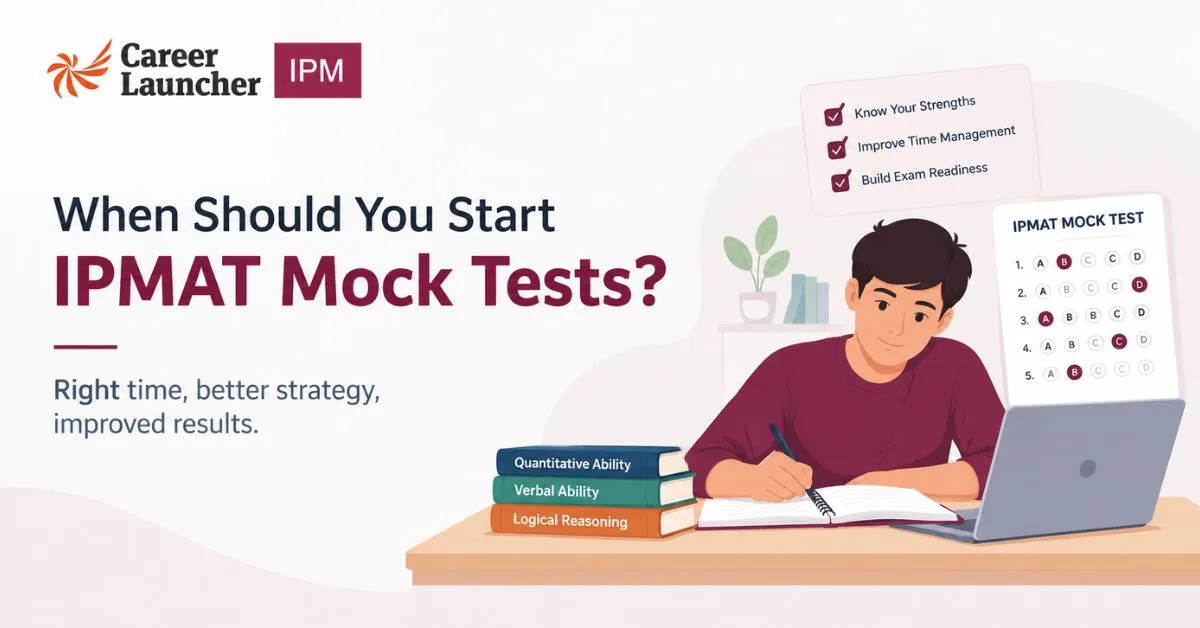
Stepping up your IPMAT preparation can feel confusing, especially when you are unsure about when should you start IPMAT mock tests. Starting too early may leave you frustrated, while waiting until the last few weeks can leave little time to improve your strategy. The right approach is to gradually introduce IPMAT mocks as your preparation develops. For beginners, mock tests should not just be about scoring marks. They should help you understand your strengths, identify weak areas, improve time management and become comfortable with the exam pattern.
Table of Contents
When Should You Start IPMAT Mock Tests?
You do not need to complete the entire IPMAT syllabus before taking your first mock. In fact, an early test can help you understand your current level and identify the areas that need more attention. However, beginners should not immediately start taking full-length mocks every few days. If you are still learning basic concepts, sectional tests, topic-wise tests and short timed quizzes are more useful initially.
Once you have covered a reasonable portion of the syllabus and become comfortable with the basic question types, you can gradually introduce full-length IPMAT mock tests. Before starting regular mocks, it is also useful to understand the IPMAT exam pattern so that you know the sections, time limits and question types you will be practicing.
Starting Your First IPMAT Mock
Your first mock should be treated as a diagnostic test, not as a measure of whether you can crack IPMAT.
You may score lower than expected, take too long on some questions or leave several questions unanswered. That is completely normal. The purpose of the first mock is to give you a starting point.
Try to take it under realistic conditions:
- Follow the actual time limit.
- Avoid using study material during the test.
- Attempt the questions independently.
- Do not pause the test unnecessarily.
- Record your score and section-wise performance.
After the test, look beyond the overall score. Ask yourself which topics felt difficult, where you lost time and whether your mistakes were caused by a lack of concepts, calculation errors or poor question selection.
If you are still at the foundation stage, your focus should remain on strengthening concepts alongside testing. A structured IPMAT preparation strategy can help you balance concept building, practice and mock tests instead of giving all your time to tests.

How Many Mocks Should You Give for IPMAT?
There is no fixed number of mocks that every IPMAT aspirant must complete. The right number depends on your preparation level, the time available and how seriously you analyze each test.
A practical approach is to increase mock frequency gradually:
|
Preparation Stage |
Mock Approach | Main Focus |
| Early preparation | Topic and sectional tests |
Concept clarity |
|
Mid-stage preparation |
Sectional tests + occasional full mocks | Speed and accuracy |
| Syllabus mostly covered | Regular full-length mocks |
Time management and question selection |
|
Final preparation |
More frequent full-length mocks |
Exam simulation and consistency |
For example, a beginner may start with one diagnostic or sectional test and then gradually move towards regular full-length mocks. As the exam gets closer, the frequency can increase.
The important point is not to chase a mock count. Twenty poorly analyzed mocks will not necessarily be more useful than a smaller number of carefully reviewed tests. Career Launcher’s preparation material similarly recommends moving from foundation building and sectional practice towards intensive mock practice closer to the exam.
IPMAT Mock Test Strategy for Beginners
A good mock strategy has three stages: prepare, attempt and review.
Before the Mock
Choose a fixed time and take the test in an environment where you will not be interrupted. Keep your rough sheets, stationery and other essentials ready. Avoid spending too much time revising immediately before the mock. The purpose is to test what you already know under timed conditions.
During the Mock
Do not assume that attempting the maximum number of questions is always the best strategy. Focus on selecting questions that offer a reasonable chance of getting the answer correct within the available time.
Keep these points in mind:
- Avoid spending too long on one difficult question.
- Do not guess blindly just to increase attempts.
- Keep track of your time.
- Identify questions that can be solved quickly.
- Maintain accuracy while improving speed.
The exact approach should also reflect the exam you are targeting. For example, IPMAT Indore and IPMAT Rohtak have different section structures, so students should build their strategy around the relevant IPMAT syllabus and exam pattern rather than using the same approach for every test.
After the Mock
Do not move directly to the next mock after checking your score. The analysis is where much of the improvement happens. Spend time reviewing the questions you got wrong, the ones you guessed, the ones you left unanswered and even the questions you solved correctly but took too long to complete.
How to Analyse IPMAT Mock Tests?
A mock score tells you where you are, but analysis tells you what to do next.
Start by dividing your questions into four categories:
|
Question Type |
What to Check |
|
Correct and quick |
Which strengths can you maintain? |
| Correct but slow |
Can the approach be made faster? |
|
Incorrect |
Was it a concept, calculation or silly mistake? |
| Un-attempted |
Was it too difficult or did you run out of time? |
Next, review your section-wise performance to identify where you are losing marks or time. If Quantitative Ability is a weak area, revisit the topics where mistakes recur and practice targeted questions using the IPMAT Maths syllabus and topic guide. For Verbal Ability or Logical Reasoning, identify the question types that affect your accuracy or take too much time. Finally, note one or two areas to improve before your next mock.
Common IPMAT Mock Test Mistakes to Avoid
Beginners often make the mistake of treating mocks as the final stage of preparation rather than as a learning tool.
Avoid these common mistakes:
- Taking full-length mocks too early: Build basic concepts and sectional skills first.
- Focusing only on the score: A score without analysis tells you very little.
- Skipping analysis: The next mock will not automatically fix the mistakes from the previous one.
- Taking too many mocks: More tests are not useful if you do not have time to review them.
- Repeating the same mistakes: Record recurring errors and work on them separately.
- Spending too long on difficult questions: Learn when to move on.
- Changing your strategy after every mock: Look for patterns across several tests before making major changes.
- Comparing every score with others: Your own improvement across mocks is a more useful measure.
A good preparation cycle should look like:
Mock → Analyse → Identify weaknesses → Practice → Review → Next mock
This cycle is more valuable than simply increasing the number of tests you take.
Conclusion
Starting IPMAT mocks at the right time can make your preparation more focused and effective. Beginners should start with sectional or diagnostic tests and gradually move to full-length mocks as their preparation improves. Instead of focusing only on the number of mocks or the score, use each test to identify mistakes, improve time management and refine your attempt strategy. With regular practice and thoughtful analysis, mock tests can help you build the speed, accuracy and confidence needed for the actual IPMAT.
Frequently asked questions
When should I start IPMAT mock tests?
You can begin with sectional or diagnostic tests once you understand the basic exam structure. Full-length mocks can be introduced gradually as you cover more of the syllabus.
Should beginners give IPMAT mocks?
Yes. Beginners can use mocks to identify their current strengths and weaknesses. However, they should start with manageable tests instead of taking frequent full-length mocks immediately.
How many mocks should I give for IPMAT?
There is no fixed number. Start with occasional tests and gradually increase full-length mocks as your preparation improves and the exam approaches.
How often should I take IPMAT mocks?
The frequency can increase from occasional tests during the early stages to regular full-length mocks during the final phase of preparation.
How do I analyze an IPMAT mock test?
Review your correct, incorrect and un-attempted questions, check time spent, identify recurring weak areas and create specific action points for your next test.
Is it okay to take an IPMAT mock before completing the syllabus?
Yes. An early mock can help you understand your current level. Just treat it as a diagnostic test rather than expecting a high score.