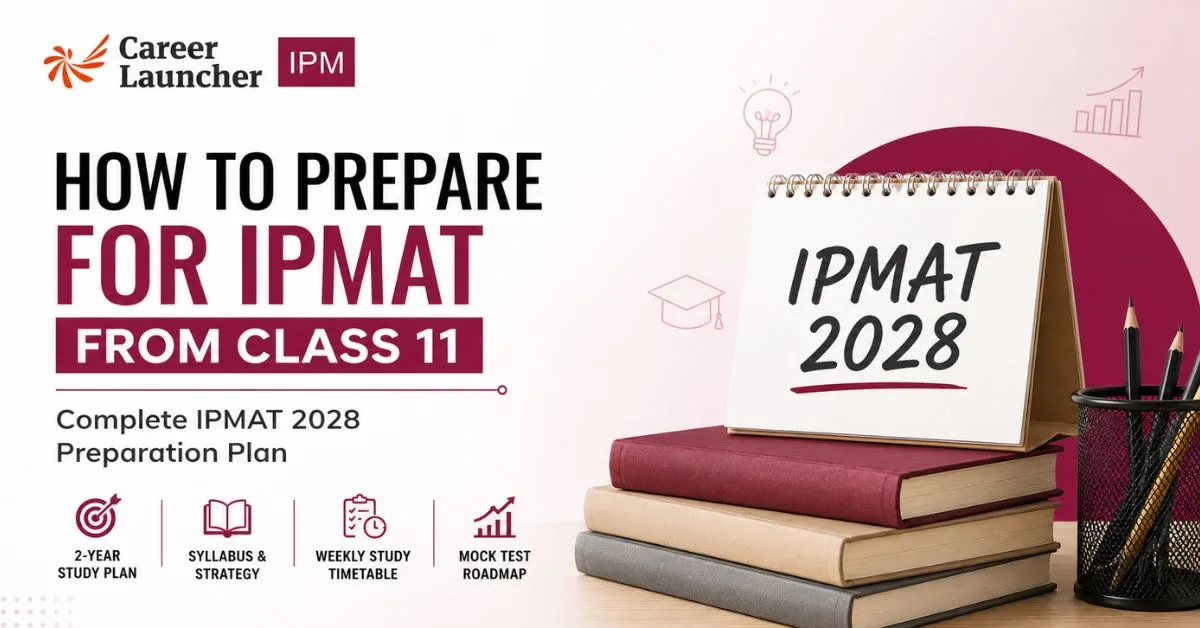
Many Class 11 students ask the same question every year – how to prepare for IPMAT from Class 11 without feeling overwhelmed. IPMAT is one of the toughest management entrance exams in India, and IIM Indore and IIM Rohtak together receive thousands of applications every season.
If you are in Class 11 right now, you are actually in the best possible position to build a strong IPMAT two-year preparation plan. This blog gives you a complete, step-by-step IPMAT 2028 preparation plan, so you never feel lost or rushed. We cover the exam pattern, syllabus, monthly targets, weekly timetables, and common mistakes to avoid. By the end of this guide, you will know exactly how to prepare for IPMAT 2028 without hurting your board exam scores or your peace of mind.
Table of Contents
What Is IPMAT and Why Class 11 Is the Best Starting Point
Before you build any preparation plan, you need to understand what IPMAT actually tests. The exam checks your quantitative ability, verbal ability, and, for IIM Rohtak, your logical reasoning too. Once you understand these basics, learning how to prepare for IPMAT from class 11 becomes much easier because you know exactly what skills to build first.
IPMAT is not a memory-based test. It checks how well you think, calculate, and read under time pressure. Students who start in Class 11 get almost two full years to build these skills slowly, while late starters often rush through the entire syllabus in a few months. Here is why Class 11 is the right time to begin:
- You get enough time to strengthen your Class 10 and Class 11 Maths and English basics before moving to advanced problems.
- You can build reading and vocabulary habits gradually instead of cramming them.
- You get more attempts at mock tests, which sharpen your accuracy over time.
- You avoid last-minute panic during Class 12 boards, since most of the syllabus is already familiar.
IPMAT Exam Pattern and Syllabus at a Glance
Knowing the IPMAT exam pattern is the real starting point of any preparation plan. IIM Indore and IIM Rohtak follow slightly different formats, so it helps to see them side by side.
IPMAT Indore vs IPMAT Rohtak exam pattern
|
Exam |
Sections | Questions | Total Marks | Duration |
| IPMAT Indore | Quant (MCQ), Quant (Short Answer), Verbal Ability | 90 | 360 |
120 minutes |
|
IPMAT Rohtak |
Quantitative Ability, Logical Reasoning, Verbal Ability | 120 | 480 |
120 minutes |
The Quantitative Ability section carries the highest weightage in both exams, so it deserves the largest share of your study time. Verbal Ability is scoring if you build strong reading habits early, and Logical Reasoning, for IPMAT Rohtak aspirants, rewards regular puzzle practice. Each correct answer earns 4 marks, and 1 mark is deducted for most incorrect answers, except in the Quantitative Ability Short Answer section of IPMAT Indore, which has no negative marking.
How to Prepare for IPMAT From Class 11 – IPMAT Two-Year Preparation Plan
An IPMAT two-year preparation plan works because it spreads the entire syllabus across 24 months instead of squeezing it into a few stressful months of Class 12. Splitting your preparation into two clear phases keeps things manageable and steady.
Class 11: Building Strong Foundations
This is the foundation phase, and it should stay light and steady.
- Cover 2 to 3 topics every week from Quantitative Ability, alongside your school syllabus.
- Read newspaper editorials and short articles daily to build vocabulary and comprehension speed.
- Revise Class 10 and Class 11 NCERT Maths concepts thoroughly, since they form the base of the IPMAT syllabus.
- Take short topic-wise quizzes instead of full mock tests, just to check your understanding.
- Devote 2 to 3 hours a day, and stretch it to 3 to 4 hours during holidays.
Class 12: Practice, Speed and Mock Tests
In the second year, the focus shifts from learning to practicing under time pressure.
- Finish revising the entire syllabus in the first three to four months of Class 12.
- Start full-length mock tests at least once a week from the middle of the year.
- Solve previous year IPMAT papers to understand real question patterns and difficulty levels.
- Work on sectional accuracy first, then gradually build speed.
- Keep an error log to track and fix repeated mistakes before the exam.
Here is a quick snapshot of how the two years fit together – Year-wise breakdown of the IPMAT two-year preparation plan
|
Phase |
Focus Area | Daily Time | Key Activities |
| Class 11 (First Half) | Basics of Quant & Verbal Ability | 2 hours |
Concept building, topic-wise practice, vocabulary |
|
Class 11 (Second Half) |
Syllabus completion, light mocks | 2-3 hours | Topic tests, reading habit, grammar practice |
| Class 12 (First Half) | Full syllabus revision | 3 hours |
Sectional tests, speed building, error log |
|
Class 12 (Second Half) |
Full mocks & previous papers | 3-4 hours |
Weekly mocks, analysis, interview prep |

How to Prepare for IPMAT 2028 – A Step-by-Step Strategy
If you are wondering how to prepare for IPMAT 2028, the answer lies in breaking the syllabus into three clear skill areas and practicing each one with purpose, rather than studying everything randomly.
Quantitative Ability Preparation Strategy
- Start with Number Systems, Percentages, Profit and Loss, and Time and Work, since these topics build a strong base for harder chapters.
- Move on to Algebra, Geometry, and Mensuration once your basics are strong.
- Practice Data Interpretation and Modern Maths closer to Class 12, since they need faster application skills.
- Solve at least 20 to 25 questions daily, and always time yourself while practicing.
Verbal Ability Preparation Strategy
- Read one editorial or short passage every single day to build reading speed and comprehension.
- Learn 10 new words daily and revise them weekly using flashcards or a vocabulary notebook.
- Practice grammar rules like tenses, subject-verb agreement, and sentence correction regularly.
- Attempt Reading Comprehension passages of different lengths and difficulty levels every week.
Logical Reasoning Preparation for IPMAT Rohtak
- Practice puzzles, seating arrangements, and blood relation questions weekly if you are targeting IIM Rohtak.
- Work on coding-decoding, syllogisms, and direction sense problems to build logical speed.
- Solve one full Logical Reasoning set every week and review your mistakes carefully.
This step-by-step approach answers the common preparation question in a structured and stress-free way, and it works equally well whether you are targeting IPMAT Indore, IPMAT Rohtak, or both.
How to Prepare for IPMAT From Class 11 – IPMAT 2028 Preparation Plan
Your IPMAT 2028 preparation plan needs a realistic weekly routine that fits around school, homework, and rest. A rigid, unrealistic timetable rarely survives more than a few weeks.
Sample Weekly Study Timetable for Class 11 Students
|
Day |
Focus Area | Approx. Hours |
| Monday | Quantitative Ability practice |
1.5 hours |
|
Tuesday |
Verbal Ability: reading & vocabulary | 1.5 hours |
| Wednesday | Logical Reasoning / weak topic revision |
1.5 hours |
|
Thursday |
Quantitative Ability practice | 1.5 hours |
| Friday | Verbal Ability: grammar & comprehension |
1.5 hours |
|
Saturday |
Full topic test or sectional mock | 2 hours |
| Sunday | Mock test analysis and revision |
2 hours |
How to Balance Board Exams and IPMAT Preparation
Many topics in the IPMAT syllabus overlap with your Class 11 and Class 12 school syllabus, especially in Maths and English. Use this overlap to your advantage instead of treating them as two separate subjects.
- Study Maths concepts once, but practice them in both school-style and IPMAT-style questions.
- Use school English classes to strengthen grammar, which directly helps your Verbal Ability score.
- Increase mock test frequency only after major school exams are over, not during exam weeks.
- Keep a shared revision calendar so board topics and IPMAT topics do not clash unexpectedly.
A balanced routine like this is an essential part of any realistic study plan because burnout helps no one.
Mock Tests and Mistakes to Avoid for IPMAT 2028 Success
Why Mock Tests and Previous Year Papers Matter
Mock tests do more than just give you a score. They show you your strong and weak areas clearly, build exam-day stamina, and help you get familiar with the computer-based test interface. No preparation plan is complete without regular mock test analysis.
- Take one IPMAT mock test every two weeks in Class 11, and increase to weekly mocks in Class 12.
- Spend at least one hour analyzing every mock, not just checking the score.
- Track your accuracy and attempt rate separately for each section over time.
- Redo the questions you got wrong after two weeks to check if the concept has actually stuck.
Common Mistakes Class 11 IPMAT Aspirants Should Avoid
- Ignoring board exam preparation completely in favour of IPMAT, which can hurt your composite score later.
- Jumping between too many books and resources instead of sticking to a focused study plan.
- Skipping weak topics repeatedly instead of practicing them extra.
- Attempting mock tests without ever analyzing the mistakes afterwards.
- Starting preparation too late and then rushing through the entire syllabus in a few months.
Start Your IPMAT 2028 Preparation Plan Today
You now have a complete roadmap and a clear IPMAT two-year preparation plan to follow, which finally answers the question of how to prepare for IPMAT from class 11. The next step is simple: pick a start date, build your weekly timetable, and stay consistent.
If you still want more guidance on how to prepare for IPMAT 2028, explore expert-designed study plans, structured mock tests, and IPMAT previous year question papers to strengthen your preparation. Additionally, you can enroll in a comprehensive Online IPMAT Coaching program, getting all the prep resources, practice materials, and expert guidance, all in one place.
Start today, stay steady, and let your two years of hard work speak for themselves on exam day.
FAQs About IPMAT Preparation for Class 11
Is Class 11 too early to start IPMAT preparation?
No, Class 11 is actually the ideal time to start. It gives you almost two years to build strong basics, practice steadily, and avoid last-minute stress before Class 12 boards and the IPMAT exam.
How many hours should a Class 11 student study for IPMAT daily?
Two to three hours a day is enough in Class 11, alongside regular school study. You can increase this to three to four hours during holidays and long weekends.
What is a good IPMAT two-year preparation plan?
This plan splits Class 11 into a foundation-building phase and Class 12 into a practice and mock-test phase, with steady weekly targets in both years.
Can I crack IPMAT without coaching?
Yes, many students clear IPMAT through self-study using NCERT books, standard aptitude guides, and regular mock tests, though structured coaching can help with expert guidance and a set routine.
What is the eligibility criteria for IPMAT 2028?
Candidates must have passed or be appearing for Class 12 board exams with a minimum aggregate score, usually around 60 percent, though the exact criteria may vary slightly by institute and category.
Which books are best to prepare for IPMAT from class 11?
NCERT Maths books for Classes 9 to 12, a standard English grammar and vocabulary book, and a quantitative aptitude book meant for aptitude exams are a good starting combination.
How do I balance board exams and IPMAT preparation together?
Focus on shared topics in Maths and English first, keep a combined study calendar, and increase IPMAT-specific mock tests only after major school exams are over.
Is Class 12 Maths compulsory for IPMAT?
No, Commerce and Humanities students without Class 12 Maths can also appear for IPMAT, though a working knowledge of Class 10 level Maths is essential.
How many attempts are allowed for IPMAT?
There is no fixed lifetime attempt limit, but candidates can generally appear for IPMAT as long as they meet the age and educational eligibility criteria set by each institute for that year.