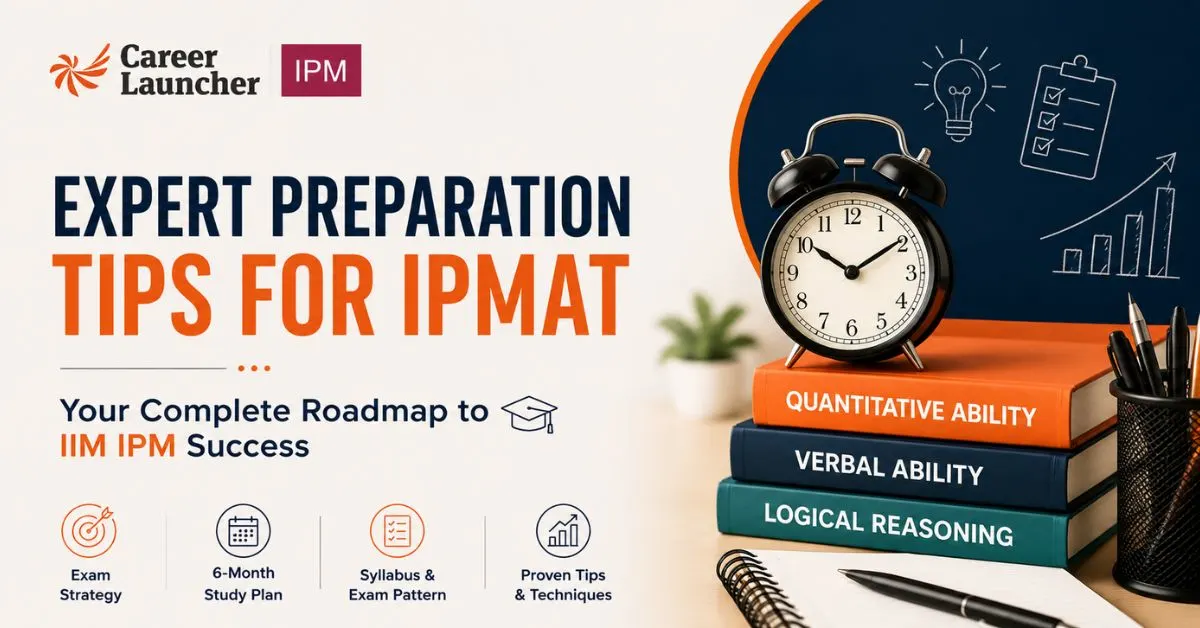
IPMAT preparation tips separate the aspirants who make it into IIM IPM from those who don’t. Unlike your board exams, IPMAT tests aptitude – not rote learning. You’ll face tightly packed sections, time pressure unlike anything you’ve seen, and competition from across the country. But here’s the good news: with a structured approach and expert preparation tips for IPMAT, cracking the exam is absolutely achievable.
This guide walks you through everything – from understanding the exam to acing your mocks – using frameworks that have helped thousands of students land their seats at IIMs Integrated Program in Management (IPM).
Table of Contents
Understand the IPMAT Exam
Before diving into preparation, you need crystal clarity on what you’re up against.
What is IPMAT and Who Should Take It?
IPMAT (Integrated Program in Management Aptitude Test) is a entrance exam conducted separately by IIM Indore and Rohtak for admission to IIMs 5-year Integrated Program in Management. A total of 5 IIMs accept the IPMAT scores for IPM admission. Details of these IIMs are mentioned below.
Seat Matrix Breakdown
|
Institute |
Primary Entrance Exam Considered | Total IPM Seats (Approx) |
| IIM Indore | IPMAT Indore |
150 |
| IPMAT Rohtak | 198 | |
| IIM Ranchi | IPMAT Indore |
60 |
| IPMAT Indore | 60 | |
| IIM Shillong | IPMAT Indore |
45 |
Key Seat Distribution Factors
- Reservation Policies: All five campuses strictly apply the national mandate across the total intake: 27% for NC-OBC, 15% for SC, 7.5% for ST, 10% for EWS, and a horizontal 5% for PwD candidates.
- Competitive Scale: Due to smaller capacities at IIM Ranchi, IIM Amritsar, and IIM Shillong, competition for individual category allotments remains exceptionally intense compared to the foundational programs at Indore and Rohtak.
The IPM program at IIMs is designed for students completing Class 12, making it unique among management entrance exams. Unlike CAT (aimed at graduates), IPMAT targets younger students (Class 12 passes/appearing) with strong foundational concepts.
The exam isn’t just about scoring high on a test – it identifies students with raw analytical thinking, reading comprehension, and logical reasoning ability.
IPMAT Syllabus & Exam Pattern – Your Three Section Battleground
The IPMAT syllabus is broadly divided into three section.
- IPMAT Indore consists of – Quantitative Ability (QA-MCQ), Quantitative Ability (QA-SA), & Verbal Ability (VA)
- IPMAT Rohtak consists of – Quantitative Ability (QA), Verbal Ability (VA), & Logical Reasoning (LR)
The brief list of important topics for each of the three sections are mentioned below.
Quantitative Ability (QA)
Covers: Algebra, Geometry, Number Theory, Arithmetic, Permutation & Combination. No calculus. Focus on speed and accuracy with conceptual clarity.
Verbal Ability (VA)
Covers: Reading Comprehension (4 passages), Verbal Reasoning, Synonyms, Antonyms, Grammar. Heavy emphasis on comprehension.
Logical Reasoning (LR)
Covers: Puzzles, Series, Analogies, Clocks, Calendars, Seating Arrangements. Tests pattern recognition over memorization.
The following is the brief IPMAT exam pattern for both the exams.
|
Exam |
Section | Questions | Time |
|
Quantitative Ability (MCQ) |
30 | 40 min | |
| Quantitative Ability (SA) | 15 |
40 min |
|
| Verbal Ability | 45 |
40 min |
|
|
Quantitative Ability |
40 |
No sectional time limit |
|
|
Verbal Ability |
40 | ||
| Logical Reasoning |
40 |

IPMAT Preparation Plan – A Structured 6-Month Study Plan
Preparation without structure is just activity. Here’s how to organize your IPMAT preparation for maximum impact.
Foundation Building
The foundation-building time is non-negotiable.
- Quantitative Ability: Review Class 11 and 12 math concepts. Solve NCERT examples. Practice one concept per day with 30 problems minimum.
- Verbal Ability: Read 2 English newspaper editorials daily. Build a vocabulary journal (20 words per week). Practice basic grammar rules.
- Logical Reasoning: Start with simple puzzles and series problems. Solve 15-20 problems daily.
Practice & Pattern Recognition
Foundation is set. Now identify your patterns and weak areas.
- Quantitative Ability: Solve previous year papers. Identify question types you consistently miss. Spend 60% time on weak areas.
- Verbal Ability: Read 5-6 passages weekly. Time yourself on comprehension questions. Maintain a phrasal verb list.
- Logical Reasoning: Attempt mixed-difficulty puzzles. Time yourself strictly – don’t exceed 1 minutes per question.
Mock Tests & Refinement
This phase is about simulation and strategy refinement.
- Full-length mocks: Take 2-3 full mocks per week.
- Analysis: Spend equal time analyzing your performance as taking the test.
- Weak areas: Take targeted mini-tests on problem areas.
- Time optimization: Experiment with section-sequencing strategies.
Expert Preparation Tips for IPMAT – Master Each Section
Students’ following random advice doesn’t crack IPMAT. It is a national-level competitive exam, which requires section-specific IPMAT preparation strategies and proven expert preparation tips for IPMAT.
Quantitative Ability: Speed Without Sacrifice
|
Mistake |
Solution |
| Rushing to solve without planning |
Write down the approach first; solve only if confident |
|
Not tracking time per question |
Aim for 2 minutes per question; skip if exceeding 2.5 minutes |
| Neglecting shortcut methods |
Learn and practice approximation and elimination techniques |
|
Weak foundations in algebra |
Spend 2 full weeks on equations, inequalities, and functions |
Action Steps:
- Master one topic per week (Week 1: Number Theory, Week 2: Percentages, etc.)
- Solve at least 50 previous year problems from each topic
- Build a “trick sheet” of shortcut methods and formulas
Verbal Ability: Reading, Vocabulary & Grammar
Reading comprehension carries 8-10 questions alone. Focus there first.
Daily Routine:
- Read 1 English newspaper editorial (The Hindu, Indian Express)
- Solve 1 reading comprehension passage with timing (12–15 minutes max for 4 questions)
- Learn 10 new words in context (not isolated flashcards)
- Revise one grammar concept (prepositions, tenses, articles)
Logical Reasoning: Practice Patterns, Not Memorization
LR tests your ability to decode patterns under time pressure.
Weekly Practice:
- Solve 3- 4 different puzzle sets (20 questions each)
- Attempt arrangement and seating problems twice weekly
- Practice series and analogy questions daily (10 questions)
- Time yourself strictly – LR rewards speed and accuracy equally
Best IPMAT Preparation Books
You don’t need 20 books to ace your IPMAT preparation. You need the right books.
Best IPMAT Preparation Books
|
Section |
Book | Author | Why It Works |
| Quantitative Ability | Quantitative Aptitude for CAT | Arun Sharma |
Clear explanations; IPM-level difficulty |
|
Verbal Ability |
Word Power Made Easy + How to Read Literature Like a Professor | Norman Lewis + Thomas C. Foster | Vocabulary in context; comprehension framework |
| Logical Reasoning | A Modern Approach to LR | R.S. Aggarwal |
Puzzle variety; good progression |
|
Mixed Practice |
IPMAT Previous Year Question Paper | Official |
Actual exam difficulty and patterns |
Pro Tip: Don’t try to finish every book. Complete one QA book, one VA book, one LR book, and solve 5 years of previous papers. That’s enough.
Online Platforms & Mock Tests
- Career Launcher’s IPMAT Test Series: Full-length mocks with detailed analysis
- The Hindu & Indian Express: Daily reading material (free online)
- Vedic Math YouTube channels: Quick shortcuts for QA
Maximize Your IPMAT Mock Test Strategy
Your IPMAT mock tests are the closest simulation to the real exam. Treat them like real exams.
When to Start Taking Mocks
- After Month 2: Start with sectional mocks (QA-only, VA-only, LR-only)
- After Month 3: Begin full-length mocks (once weekly)
- Months 5–6: Increase to 2–3 full mocks per week
Analyzing Your Performance: A Data-Driven Approach
After every mock, answer these questions:
- Accuracy by section: Which section had the most errors?
- Time distribution: Did you waste time on low-value questions?
- Question-type performance: Did you struggle with specific question types?
- Careless errors vs. knowledge gaps: Which type dominated your mistakes?
Spend as much time analyzing as taking the test. Your analysis sheet becomes your study roadmap.
Stay Motivated & Avoid Common Pitfalls
Common IPMAT Preparation Mistakes (And Solutions)
|
Mistake |
Why It Fails | Fix |
| Taking mocks too early | You haven’t learned concepts yet; discouraging scores |
Start mocks after Month 3 only |
|
Solving 10,000 problems |
Quantity without understanding wastes time | Solve 50–100 problems per topic, deeply |
| Ignoring previous year papers | You miss actual exam patterns and difficulty |
Solve 5 years of papers by Month 4 |
|
No time tracking |
You don’t know your speed-accuracy tradeoff | Time every mock and practice session |
| Last-minute preparation panic | You rush and make careless errors |
Finish the syllabus by Month 5 |
The Final 30 Days: Your Power-Up Period
- Solve 1 full mock every 2 days
- Revise formulas and shortcuts daily (15 minutes)
- Sleep well—don’t sacrifice sleep for extra hours
- Avoid learning new concepts; reinforce what you know
- Stay off social media 2 weeks before the exam
Your Final Roadmap to IIM After Class 12
IPMAT preparation isn’t a sprint – it’s a structured roadmap guided with expert preparation tips for IPMAT. You’ll have days when concepts click and days when you feel stuck. That’s normal.
Remember: every mock you take, every previous year paper you solve, every weak area you address is moving you closer to your seat at IIM Indore.
Start building your foundation today. Explore Career Launcher’s IPMAT online coaching to boost your IPMAT preparation with live classes, full-length mocks, practice questions, expert guidance, PDP-prep, and much more.
Your roadmap is clear. The question is: are you ready to walk it?
Your IPMAT Preparation Questions Answered – FAQ
Q1: How many hours per day should I study for IPMAT?
A: 4-5 hours daily for 6 months is the sweet spot. Quality beats quantity. Focused 4 hours beats distracted 8 hours every time.
Q2: Can I crack IPMAT without coaching?
A: Absolutely. Many top IPMAT scorers are self-taught. You need discipline, a structured plan, and access to resources (books, mocks, previous papers). Coaching isn’t mandatory—it’s an accelerator if you’re stuck.
Q3: What’s the ideal mock score to ensure IIM IPM admission?
A: Scores above 85th percentile in mocks correlate strongly with admission. But mocks are easier than the real exam, so aim for 90th+ percentile consistency.
Q4: How do I improve accuracy in quantitative ability?
A: Accuracy comes from strong concepts, not speed. Slow down for 2 weeks, focus on understanding why each step works, then rebuild speed. Use approximation and elimination methods to save time without sacrificing accuracy.
Q5: Is IPMAT easier than CAT or XAT?
A: IPMAT is different, not easier. QA is slightly easier (no calculus). But VA and LR demand deeper comprehension than CAT. They’re targeting younger students, so the pace and depth differ.
Q6: How many mock tests should I take?
A: Take 15–20 full-length mocks. More than 20 becomes redundant. But ensure you analyze each one deeply.
Q7: What if I’m struggling with logical reasoning?
A: Slow down. LR is pattern-based, not speed-based. Spend 4 weeks solving easy-to-medium puzzles without time pressure. Once patterns click, add time constraints. Many students rush before understanding patterns.