GMAT Exam 2026: Exam Dates, Registration, Pattern, Syllabus & Preparation
Updated on 30th June 2026 | 05:50 PM
The Graduate Management Admission Test (GMAT) is a standardized exam that plays a key role in business school admissions. This computer-adaptive exam tests a candidate's critical thinking, problem-solving, and data analysis abilities. Trusted by over 7,700 programmes at 2,400+ business schools worldwide, the GMAT is the most widely used assessment designed specifically for graduate business education. The Graduate Management Admission Council (GMAC) has made the GMAT exam one of the most important factors in determining whether a student is accepted into the program. As of 2026, the GMAT is conducted exclusively in the GMAT Focus Edition format, which features a shorter duration, three core sections, and a greater emphasis on data-driven and business-relevant skills. Understanding the current GMAT exam pattern, including these recent changes, can help you prepare better and get the score you want.

Key things to know!
- The Graduate Management Admission Council (GMAC) is the official body that administers the GMAT exam.
- The GMAT is an important MBA admissions test.
- It assesses how ready you are for graduate business schools.
- Skills tested: your ability to make decisions, tackle problems, think critically, and break down data.
- There are 3 sections: Verbal Reasoning, Quantitative Reasoning, and Data Insights.
- It has 64 questions in total: Quantitative Reasoning: 21 questions; Verbal Reasoning: 23 questions; and Data Insights: 20 questions.
- The exam takes 2 hours and 15 minutes (with one optional 10-minute break). Each section lasts 45 minutes.
- The scoring system has been updated as follows:
- Total score range: 205 to 805
- Individual section scores: 60 to 90 (in 1-point increments)
- Age requirement: You must be at least 18 years old to register. Candidates aged 13-17 may test at a test centre with written parental/guardian consent.
Related Topics
-
Which Indian B-Schools Accept GMAT?
-
How to prepare for GMAT
- GMAT vs GRE
- GMAT vs CAT
- GMAT Focus Edition score
- GMAT score for harvard
- Admission deadlines for top B Schools
- How to send GMAT scores to B Schools?
- Tips to improve GMAT data insights score
- GMAT Scores for Top Global MBA Colleges
- MBA Deadlines for Top B Schools
- What Is the GMAT Focus Edition?
- What is the GMAT Exam?
- What Is the Purpose of the GMAT Exam?
- What Are the Benefits of Taking the GMAT?
- Who Should Take the GMAT?
- GMAT Exam Eligibility Criteria
- GMAT 2026 Exam Dates
- GMAT Exam Date 2026: Pointers to Note
- GMAT Test Modes
- GMAT Exam Registration
- GMAT Exam Fees 2026
- GMAT Exam Pattern
- GMAT Exam Syllabus
- What is the Difference Between GMAT and GRE?
- GMAT Hall Ticket
- GMAT Scoring 2026: Score Range, Percentiles & Concordance
- GMAT Score Report: When & How You Receive Results
- GMAT Test Score Cutoff
- What is the Validity of the GMAT Exam Score?
- How Hard is the GMAT Exam?
- Tips & Strategies to Achieve a High Score
What Is the GMAT Focus Edition?
The GMAT Focus Edition is the current and only version of the GMAT exam, having fully replaced the previous format on February 1, 2024. It was designed to be more streamlined, business-relevant, and accessible. Here is what changed from the previous version:
|
Feature |
Previous GMAT |
GMAT Focus Edition (2026) |
|
Number of sections |
4 (Quant, Verbal, IR, AWA) |
3 (Quant, Verbal, Data Insights) |
|
Total score scale |
200–800 |
205–805 |
|
Sentence Correction |
Present in Verbal |
Removed |
|
Analytical Writing Assessment (AWA) |
Present (separate section) |
Removed |
|
Question Review & Edit |
Not available |
Up to 3 answers per section |
|
Flexible Score Sending |
Not available |
View scores first, then send |
|
Duration |
~3 hrs 7 mins |
2 hrs 15 mins |
What is the GMAT Exam?
Every individual interested in pursuing an MBA abroad would be familiar with the GMAT. This is the most popular MBA entrance exam in the world. GMAT scores qualify a candidate in pursuing MBA from well-coveted B-schools like Harvard Business School, INSEAD, Stanford, Wharton, etc. The GMAT is accepted by over 7,700 programmes at 2,400+ business schools across 110+ countries.
A good GMAT score can not only fetch your choice of a master's program from a targeted university but also help you land your dream job. Administered by GMAC. The marking scheme of GMAT is the same for test takers worldwide to ensure impartiality. In simple words, appearing for the GMAT exam gives you an idea of what skills you need to have to pursue an MBA program. from your dream college.
In the last 5 years, the average GMAT scores of Indian applicants have been more than other candidates from all across the globe. This means that despite being one of the most exhaustive and challenging examinations, candidates from our country understand the potential in scoring well in GMAT. Indian applicants had increased acceptance rates in the top 21-50 international B-schools, with a 32% chance of acceptance for scores between 740-750. It is important to note that these figures are based on the legacy GMAT format. As we move to the GMAT Focus Edition, we expect changes in average and median GMAT scores across the board.
Students wondering when is the right time to take GMAT should know that it is offered on-demand and year-round in either online or offline mode. Read on to find everything about the GMAT exam in detail.
What Is the Purpose of the GMAT Exam?
While your grades and work history count, the GMAT serves as a universal benchmark for B-schools and evaluates you on a global scale. The skills assessed on this exam ensure you have the essential aptitude and competencies to excel in a rigorous MBA program. In essence, the GMAT is designed to test the capabilities that are directly relevant to your future success.
By taking the GMAT, you demonstrate your commitment to pursuing a business education and stand out from a large pool of candidates vying for spots in prestigious MBA programs.
Understand the purpose in detail:
- Gives the admissions committee a measure of how ready candidates are for graduate-level business studies.
- Sets a standard to compare candidates from different walks of life.
- Shows how much one is dedicated and passionate about getting into an MBA program.
- Shows that an applicant is ready to handle a tough graduate program.
- Checks how well someone can think and make choices when dealing with data. These skills are key in today's business world.
- For the schools, GMAT scores impact their class profile and can change their spot in rankings, influencing their ability to draw in the best applicants.
While the GMAT is a strong tool for MBA admissions, it is important to keep in mind that it's one part of the bigger picture. Admissions teams look at GMAT scores as part of a full review considering other things like job experience, leadership potential, and personal traits.
What Are the Benefits of Taking the GMAT?
Taking the GMAT exam offers advantages that can significantly shape your academic and professional journey. Here’s why you must consider it:
Better Chances of Admissions
A good GMAT score shows you're ready for advanced business classes. It boosts your odds of getting into top business schools in the US. Many well-known B-schools consider the GMAT as a reliable predictor of how well you will do in class, so it is a big part of your application.
Wide Acceptance
The GMAT's widespread acceptance contributes to its popularity. It extends beyond MBA programs; many master's programs in management, like Master in Management (MiM), Master in Entrepreneurship and Management (MiEM), and business analytics programs also consider GMAT scores. This flexibility provides you with more choices when you apply to graduate business programs.
Financial Benefits
Your GMAT score has a big influence on your financial future. Business schools often use GMAT scores to decide who gets scholarships. A better score can boost your chances of winning bigger scholarships, including full-tuition offers. Additionally, a high score, for example 735+ instead of 705, can yield an incremental return on investment (ROI).
Career Advantages
The benefits of a strong GMAT score extend beyond academics. Many top employers, particularly in industries like consulting and investment banking, consider GMAT scores during their hiring process. The exam showcases your mastery of skills highly relevant in business careers, including problem-solving, data analysis, and critical reasoning.
Flexibility and Convenience
Your GMAT score remains valid for five years, giving you ample time to decide on your graduate education plans. This flexibility lets you keep your options open in your career.
Who Should Take the GMAT?
The GMAT is a valuable exam for various individuals pursuing management education and career advancement. You should consider taking the GMAT if you fall into one of the following categories:
- Aspiring MBA Candidates
If you're planning to apply to MBA programs, taking the GMAT is essential. Your GMAT score showcases your quantitative and problem-solving abilities, critical thinking skills, and readiness for the rigors of business school.
- Undergraduate Students
As an undergraduate student, you are in a great spot to take the GMAT. Your mind is primed for learning, so you will grasp GMAT concepts more now than you would later in your career. Additionally, it is easier to fit GMAT prep into your schedule as a student compared to when you have a full-time job. Your score stays valid for five years giving you plenty of time to figure out your grad school plans. By the time you are ready for application, you can focus on developing other aspects of your application, such as leadership skills and work experience.
- Career Switchers
If you're considering a career change into management-related fields, the GMAT can be an asset. Taking the exam shows you're serious about a business career and proves you've got the skills that matter in business classrooms and jobs.
- Finance and Consulting Aspirants
If you're aiming for a job in finance or consulting, a good GMAT score can boost your chances. Many of the big companies in these fields look at GMAT scores when they are hiring. Getting a high score shows employers you have got the analytical thinking, problem-solving, and quantitative competencies they seek in MBA-level candidates.
GMAT Exam Eligibility Criteria
The Graduate Management Admission Test (GMAT) is conducted by the GMAC and is open to candidates from around the world. However, a candidate's eligibility should be ascertained before registering for GMAT. In addition, the eligibility criteria of GMAT should always be considered keeping in mind the eligibility criteria of your preferred B-school. If you match the GMAT requirements but fail to match the eligibility of your targeted business program, you will be denied admission, no matter how good your GMAT scores are. A student can appear for the GMAT only 5 times within a year.
Understand basic GMAT eligibility through the help of below given picture:
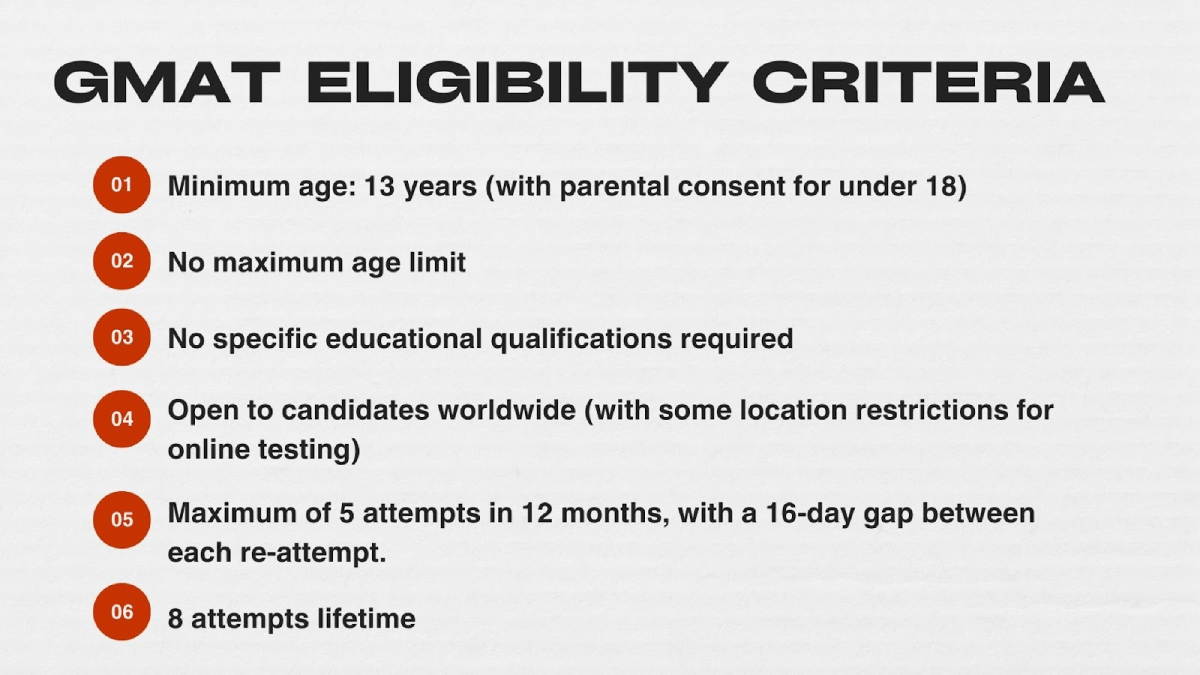
Note: If you are between 13 and 17 years old, you may take the exam at a test centre only if you provide written proof of parental or guardian consent prior to scheduling.
GMAT 2026 Exam Dates
The GMAT offers flexible scheduling options for candidates. Here's what you need to know about GMAT exam dates in 2026:
Year-Round Availability
- The GMAT is available throughout the year, so pick a date that best suits your schedule.
- Both registration and exam dates are open year-round.
Registration Process
- You can register up to 180 days before your preferred test date.
- During registration, you will see a calendar showing available exam slots.
- It is recommended to register 60-90 days before your preferred exam date to ensure you get a spot.
Scheduling Tips
- After your one attempt, you’ll need to wait for 16 days before you can take the exam again. Think about this when you're planning your schedule, in case you need to take it twice.
- Try to take your first GMAT 2-3 weeks before any application deadlines. This gives you time to take it again if you need to.
Missed Appointment Policy
If you miss your scheduled GMAT appointment without cancelling, your exam fee is forfeited.
You must wait 24 hours from the missed appointment time before scheduling a new exam (at full fee).
Free reschedule or full refund may be available for documented medical emergencies, military orders, or bereavement — requires supporting documentation and is reviewed case by case.
GMAT Exam Date 2026: Pointers to Note
Here is a summary of all the points you need to keep in mind while booking your GMAT slot. The date you choose for taking the GMAT exam will determine your entire plan of action till the GMAT is over.
|
Gathering complete information |
|
|
Allotting time spans to all registration activities |
1. Decide which mode of payment you want go for. You can use VISA, Mastercard, American Express, and Discover Network Cards for the payment. 2. If you plan to take the GMAT offline, set aside time for checking the testing arrangements. |
|
Schedule your GMAT Exam Online |
|
GMAT Test Modes
The GMAT offers two primary modes of testing to ensure diverse candidate needs and preferences are met:
GMAT Test Offline Mode (at Test Center)
The traditional method of taking the GMAT is at a physical test center. This option provides a controlled environment designed for standardized testing.
Offline or test centre GMAT is the primary and the oldest option for taking GMAT. To know how to take GMAT through a distinguished test centre which is monitored by Pearson VUE, a candidate needs to read up Testing Rules Agreement. This agreement will enlighten you on the various test policies and inform you of exam day guidelines.
Candidates need to make sure that their preferred test centre should be available on the exam date they’ll book during GMAT registration. As the GMAC is allowing gradual openings of test centres for GMAT all across the globe, candidates can easily resort to the old traditional variant of giving GMAT in an exam centre that is near to their residential location.
Here are the necessary exam day practices you should follow to ensure clear and fair GMAT test-taking experience:
- Present appropriate identification through an identity proof recognized by the government of your country attesting your credibility as a valid citizen.
- Provide a palm vein scan as and when required. Only after it matches with the palm vein pattern you provided at the time of submitting your ID proof, you will be allowed inside the test centre.
- Provide your digital signature stating that you have read the test agreement of GMAT and agree with all the clauses mentioned in the agreement.
- Let the examiner take your digital photograph and sit patiently for the same.
- Start your GMAT only after your examiner allows all the candidates to login to the test portal.
GMAT can be stated as the most challenging exam in the world. To ensure sure success, it is vital to undertake the essence of the right type of GMAT coaching.
Enroll for GMAT Online CoachingGMAT Online Mode
In response to global needs and to increase accessibility, the GMAT is also available in an online format that can be taken from home.
Both test modes cover the same content and are equally accepted by business schools. You can choose between the test center and online GMAT based on your preference, location, and other circumstances.
Here are some points that are the same for both the online and test center GMAT exam:
- Over 7,700 programs at more than 2,400 business schools accept the test.
- The test lasts 2 hours and 15 minutes.
- There are a total of 64 questions split in to 3 sections: Quantitative Reasoning, Verbal Reasoning, and Data Insights.
- You can pick the order of sections based on what you like.
- You can bookmark and review your answers. You can also change up to 3 answers in each section as long as you have time left.
- The total score ranges from 205 to 805, with all 3 sections carrying equal weight in your final score.
- Official scores are accessible on your mba.com account typically within 7 business days, though it may take up to 20 business days. You will receive an email when your report is ready. (Source: mba.com)
- Scores stay valid for 5 years.
- 5 attempts in any 12-month period; 8 attempts in a lifetime.
- 5 free score reports to programmes within 48 hours of receiving your Official Score. Additional reports incur a fee.
Fee Waiver Note
GMAT exam fee waivers are available through participating business schools. GMAC does not issue fee waivers directly to test takers. Contact the school(s) you plan to apply to if you need a fee waiver.
Explore GMAT Classroom Programme for freshers as well as working professionals to learn the real mantra of acing GMAT by CL experts. Get in touch with the representatives to gain insights on course deliverables.
Comparison of GMAT Online and Offline Exam Mode
|
Aspects |
Test Center |
Online |
|
Appointment Availability |
You can book 7 days a week when the test center is open. |
You can book 24/7, any day of the week. |
|
Cost |
Fees vary from $250 to $275, based on location. |
Fees vary from $275 to $310, based on location. |
|
Resources |
You get 5 laminated sheets and 2 dry erase markers. |
You can use a real whiteboard with a marker and eraser, plus you have access to an online whiteboard. |
Note on India: Candidates taking the test from the Indian subcontinent require their e-Aadhaar (electronic Aadhaar) in PDF format as proof of identification. The name and date of birth must match the GMAT registration form.
GMAT can be stated as the most challenging exam in the world. To ensure sure success, it is vital to undertake the essence of the right type of GMAT coaching. Read this article to address your concerns regarding GMAT classroom coaching and make a thought-out decision.
GMAT Exam Registration
GMAT registration takes place online by visiting mba.com and creating your account. It is recommended to register 90 days before the examination.
Key Steps to Register for GMAT
- Candidates can log in to the official website and fill out their registration form.
- Name, email, and password would be required for account creation of the candidate.
- Personal details, academic details, work experience, and documentation need to be entered
- The candidate can schedule the examination as per his/her convenience through the flexible slot booking option.
- After the test date and country/location are chosen, the candidate must pay a fee of US $275 for the exam at a test center and $300 for the exam delivered online.
- In case, the candidate wishes to book their test data offline, they can do so via phone or postal mail.
- Candidates can take a printout of the application form and affix a photograph for later admission formalities.
- Candidates can fill the application form throughout the year.
GMAT Exam Fees 2026
GMAT exam fees vary by location, delivery channel, and applicable local taxes. In the US, fees are currently US $275 for a test centre exam and US $300 for the online exam. Candidates in India should check the official Exam Payment page for current India-specific pricing.
Modes of Payment for GMAT Exam Fee
- Online: VISA, Mastercard, American Express, and Discover Network Cards.
- Postal Mail: Cheque or money order payable to Pearson VUE-GMAT, in US dollars, drawn on a US bank.
- GMAT customer care booking: An additional USD 10 is charged.
GMAT Exam Cancellation & Rescheduling Fees
Note: Fees below are based on the standard US pricing. Always refer to the most up-to-date, location-specific fees.
|
Cancellation Timeframe |
Refund Amount |
|
60+ days before exam date |
US $110 Refund |
|
15–60 days before exam date |
US $80 Refund |
|
14 days or less before exam date |
US $55 Refund |
|
Rescheduling Fee |
|
|
0-14 days before exam |
Fee of US $165 |
|
15-60 days before exam |
Fee of US $110 |
|
>60+ days before exam |
Fee of US $55 |
GMAT Exam Pattern
GMAT has a defined exam pattern. The mode of the GMAT is “personalized” and “online proctored” where the medium of language is English. The duration of the exam is 2 hours and 15 minutes in total. The paper is divided into three major sections,
- Verbal Reasoning
- Quantitative Reasoning
- Data Insights
A candidate needs to answer all the 64 questions within a specific time duration without leaving any questions unanswered. If you do not complete a section of the exam within the given time, your score will be reduced based on how many questions are left unanswered.
Here is a descriptive overlay of GMAT exam pattern:
|
Section of GMAT (Order-wise) |
Time Duration |
Number of Questions |
Computer Adaptive |
|
Verbal Reasoning |
45 minutes |
23 Questions |
Yes |
|
Quantitative Reasoning |
45 minutes |
21 Questions |
Yes |
|
Data Insights |
45 minutes |
20 Questions |
Yes |
Video Explaining GMAT Exam Pattern, Scoring System and Exam Order
GMAT Exam Syllabus
The GMAT Focus Edition tests three core areas. Here is a breakdown of topics covered in each section:
|
Section |
Question Types |
Topics Covered |
|
Quantitative Reasoning |
Problem Solving |
Arithmetic, algebra, geometry (basic), number properties, ratios, percentages, rates, statistics, probability |
|
Verbal Reasoning |
Reading Comprehension Critical Reasoning |
Understanding complex texts, drawing inferences, identifying assumptions, strengthening/weakening arguments, evaluating argument structure |
|
Data Insights |
Data Sufficiency Multi-Source Reasoning Table Analysis Graphics Interpretation Two-Part Analysis |
Interpreting charts/graphs, evaluating data from multiple sources, determining data sufficiency for quantitative problems, combined verbal and quantitative reasoning |
For a detailed topic-by-topic breakdown, refer to our complete GMAT Syllabus guide and GMAT Exam Pattern overview.
What is the difference between GMAT and GRE?
GMAT is mostly taken by the candidates who are looking to associate themselves with the world's leading universities, as management graduates (MBA) or Masters in Management (MIM). The acceptability of GMAT scores is way more than any other aptitude test.
|
Feature |
GMAT Focus |
GRE |
|
Designed for |
Graduate business programmes (MBA, MiM) |
Wide range of graduate programmes |
|
Score scale |
205–805 (total); 60–90 (sections) |
260–340 (total) |
|
Validity |
5 years |
5 years |
|
Acceptance |
7,700+ programmes at 2,400+ B-schools |
Broad acceptance across many disciplines |
|
Calculator allowed |
Data Insights section only |
Yes — all sections |
GMAT Hall Ticket
Students appearing for GMAT get a confirmation letter in place of the regular admit card. The confirmation letter can be downloaded from the official website. Candidates are also advised to carry a printout of the confirmation letter on the D-day. The components of the letter are going to be as follows:
- Candidate’s name
- Exam center
- Exam Date
- Exam time
- Authorized Signatory
- Candidate Signature
- Instructions/Guidelines to follow
GMAT Scoring 2026: Score Range, Percentiles & Concordance
The GMAT Focus Edition introduced an updated scoring system, with the total score range shifting from 200-800 to 205-805. All three sections contribute equally to the total score.
|
Score |
Range |
Interpretation |
|
Total Score |
205–805 (Increments of 10) |
Calculated equally from all 3 sections. |
|
Quantitative |
60–90 (Increments of 1) |
Based on number of correct answers and difficulty level of each question. |
|
Verbal |
60–90 (Increments of 1) |
Adaptive — scores based on how many questions you get right and the difficulty of each question. |
|
Data Insights |
60–90 (Increments of 1) |
Computer-adaptive — difficulty adjusts based on performance, impacting the final section score. |
GMAT Focus Edition Score Concordance & Percentiles
A GMAT Focus Edition score of 645 is equivalent to 700 on the previous GMAT exam — both represent approximately the 86th–87th percentile.
A score of 545 represents approximately the 50th percentile.
A score of 755–805 places a candidate at the 99th+ percentile.
GMAT Score Report: When & How You Receive Results
Here's what you should know about getting your GMAT scores:
- Immediate Unofficial Scores: As soon as you finish the GMAT, you'll see a preview of your unofficial scores on the screen - Quantitative Reasoning, Verbal Reasoning, Data Insights, and Total Score. You cannot save, print, or record these scores.
- Official Score Report: Official scores are accessible on your mba.com account typically within 7 business days, though it may take up to 20 business days. You will receive an email when your Official Score Report is ready. You can download your score report as a TXT, CSV, or PDF file.
- Sending Scores to Schools: Your GMAT scores stay valid for 5 years. You can send your scores to up to 5 programmes at no cost within 48 hours of receiving your Official Score. After this window, or for additional schools, you will need to pay a fee.
- Accessing Your Scores: Sign in to your GMAC account on mba.com to view, download, and send your score reports.
GMAT Test Score Cutoff
GMAT Score cutoff varies depending on factors such as the exam's difficulty level, number of candidates taking the test, seat vacancies, and average scores. While there isn't a fixed minimum/maximum score for the GMAT Focus exam, a score of 655-705 and above is competitive for top 10 universities.
Please note: A GMAT Focus Edition score of 645 equals a 700 on the previous GMAT exam. Both represent approximately the 86th-87th percentile.
- The total GMAT score range for the Focus Edition is 205-805.
- A GMAT score of 755-800 ranks a candidate in the 100th percentile. The table below lists some of the top B-schools' minimum average/median GMAT scores for the class of 2026:
|
S.No |
University |
Avg GMAT Legacy Score |
Avg GMAT Focus Score |
|
1 |
Stanford University |
738 |
689 |
|
2 |
Northwestern University (Kellogg) |
733 |
687 |
|
3 |
740 |
675 |
|
|
4 |
University of Chicago (Booth) |
736 |
670 |
|
5 |
University of Pennsylvania (Wharton) |
735 |
676 |
|
6 |
730 |
685 |
|
|
7 |
Columbia University |
734 |
690 |
|
8 |
Dartmouth College (Tuck) |
727 |
671 |
|
9 |
MIT (Sloan) |
720 |
675 |
|
10 |
UCLA (Anderson) |
703 |
- |
|
11 |
UC Berkeley (Haas) |
730 |
675 |
| 12 |
- |
~670 |
|
| 13 |
IIM Ahmedabad |
- |
~648 |
Note: Scores marked ~ are estimates converted from Classic GMAT averages using the official GMAC concordance table, or based on reported competitive ranges from multiple admissions sources. Schools are progressively publishing Focus Edition data. Check official sources for the latest updates.
For institutes that accept GRE scores, the GMAT scores can be calculated using the GRE to GMAT calculator.
Have a look at a few other benchmarks to get a holistic picture:
- Top Indian B-schools (ISB, IIMs): The average GMAT score at top Indian programs sits in the 655 - 685 range. A score of 675+ is competitive but no longer enough to stand out in a strong applicant pool. See the full picture in our guide to GMAT Scores for Top Indian B-Schools (ISB, IIMs & More).
- Top global MBA programs: For schools like Harvard, Wharton, and Stanford, median scores sit at 685+. Our breakdown of GMAT Scores for Top Global MBA Colleges maps requirements across 20 programs.
- MiM programs in Europe: Master's in Management programs often have lower score thresholds, but top schools like HEC Paris and London Business School are still competitive. Check our GMAT Scores for Top MiM Programs guide for the full list.
Set your target before you build your study plan. Your plan for a 605 looks different from your plan for a 705. If you're still figuring out what qualifies as a strong score for your profile, our article on What is a Good GMAT Score? walks through this.
What is the validity of the GMAT Exam Score?
One of the major things to note is the term of score validity. GMAT exam scores are valid for a period of 5 years. The candidate must keep this in mind while taking up the admission process, so as to properly fix upon exam dates.
How Hard is the GMAT exam?
Many people see the GMAT exam as a tough test, but how hard you find it depends on how well you prepare and your abilities. As a computer-adaptive test, the GMAT tailors questions to your ability, making it a unique experience for each test-taker. One of the key challenges of the GMAT is managing your time effectively. With a total test duration of 2 hours and 15 minutes, you need to keep a steady pace through each section. Consistent study and practice are crucial to familiarize yourself with the exam format and question types.
Tips & Strategies to Achieve a High Score
It can be overwhelming to prepare for an exam that is known for having a high score bar but preparing the right way and taking the right steps will determine the result. While there are many tips and advice out there to obtain high GMAT scores, there are a few fundamentals that cannot be ignored. Some of these fundamentals are mentioned below for your perusal:
- Laying down the study plan: It is extremely important for every candidate to plan and strategise for their GMAT Exam attempt. Preparing blindly without thinking about how it would help in the exam leaves too much to chance.
- Tracking your preparation through GMATPrepSoftware: One of the first things that every candidate should be doing is downloading GMATPrepSoftware. This application allows candidates to assess their preparation and helps in setting a target score. Track your preparation using GMAT Official Practice, available at mba.com. It includes free practice questions, full-length practice exams, and a personalised prep plan tool. Official practice exams are the strongest indicator of your likely GMAT score.
- Knowing the GMAT exam format: It is extremely important to be familiar with the GMAT Exam Format. It increases the chances of cracking the exam and leaves very little room for blunders or surprises on the day of the exam.
- Timing the mock practices: Time management during the GMAT is critical. Timing personal mocks at home enables improvement in the accuracy of finishing the exam on time. It is crucial to manage your time well across all sections due to the sectional time limits. During personal mock practices, ensure you are following the official GMAT section structure.
Recommended GMAT prep resource: GMAT Official Practice
You can also access our Free GMAT Study Plan and take a GMAT Diagnostic Test to assess exactly where you stand before Month 1 begins.
Related Topics for GMAT Preparation
How to prepare for GMAT while working GMAT Preparation Tips Personalized GMAT PlanWant to crack GMAT in one go? We hear you. Joining GMAT online classes today will help discover a new way of learning even from far away. Consult our experts to get suitable information regarding the course context.
Read More About GMAT Preparation Strategy
FAQ's
GMAT stands for Graduate Management Admission Test. It is a standardised, computer-adaptive exam conducted by GMAC (Graduate Management Admission Council) to assess candidates' readiness for graduate business programmes worldwide.
As of July 1, 2024, GMAC dropped the "Focus Edition" label and reverted to simply calling it the GMAT Exam, since it is now the only version available. The exam consists of three 45-minute sections â Quantitative Reasoning, Verbal Reasoning, and Data Insights â bringing the total test time to 2 hours and 15 minutes. Scores now range from 205 to 805.
No. While the GMAT is widely used for international MBA admissions, it is also accepted by several top Indian business schools, including ISB Hyderabad, select IIMs for executive programmes, XLRI Jamshedpur, and SP Jain Institute of Management & Research. If you are targeting a global MBA â or a premium Indian B-school â the GMAT is a strong option.
Yes. Leading Indian institutions that accept GMAT scores include ISB, IIM Ahmedabad, IIM Bangalore, and IIM Calcutta for their PGPX (executive) programmes, XLRI Jamshedpur, and SP Jain Institute. For regular two-year MBA programmes at IIMs, CAT remains the primary requirement.
Most top business schools now accept both, but the GMAT continues to be the preferred exam for MBA admissions. Business schools worldwide trust the GMAT to provide a reliable indicator of academic potential and professional readiness for management programmes. If you are stronger in data reasoning and critical thinking, the GMAT may suit you better. The GRE typically places more emphasis on vocabulary. Attempting official practice tests for both is the best way to decide.
CAT is designed for admission to Indian B-schools, primarily IIMs, and scores are valid for one year. The GMAT is accepted by over 7,700 programmes across 114 countries and scores are valid for five years. You can take the GMAT up to 5 times in any rolling 12-month period, with a mandatory 16-day gap between attempts, and GMAC removed the old 8-attempt lifetime cap in October 2024. CAT is offered once a year. If you plan to apply abroad or to executive MBA programmes in India, the GMAT is the better long-term investment.
They test different skills. The GMAT Verbal section focuses on Critical Reasoning and Reading Comprehension of complex, business-oriented texts. Sentence Correction has been removed from the current GMAT, making it more focused on analytical reading. The SAT verbal section tests a broader range of language skills and is generally considered less business-specific.
Yes, but only up to a high school level. Geometry has largely been removed from the Quantitative Reasoning section, and Data Sufficiency questions have moved to the Data Insights section. The Quantitative section now covers arithmetic, algebra, and statistics through 21 problem-solving questions in 45 minutes.
An on-screen calculator is provided for the Data Insights section, but you cannot use a personal calculator for the Quantitative Reasoning section.
Yes â this is a key feature of the current GMAT. A Question Review & Edit feature allows test-takers to bookmark questions and change up to three answers per section before the section ends. This was not available on the previous version of the exam.
The current GMAT score ranges from 205 to 805, always ending in a 5, with 10-point intervals. Each of the three sections is scored on a scale of 60 to 90, and all three sections contribute equally to the total score. A score of 655+ is considered very competitive for top global programmes.
Yes. There is no upper age limit for the GMAT. Many leading executive MBA programmes actively seek experienced professionals, and a strong GMAT score strengthens your profile regardless of age. Several IIMs, ISB, and global schools specifically design programmes for candidates with 8â15 years of work experience.
No work experience is required to register for or take the GMAT. However, most top MBA programmes expect 2â5 years of professional experience at the application stage. Taking the GMAT early and keeping your score (valid for five years) is a smart strategy.
You must be at least 18 years old to register independently. Candidates aged 13â17 may take the exam at a test centre only with written parental or guardian consent.
If you miss your scheduled GMAT appointment without cancelling, your exam fee is forfeited and you must wait 24 hours before rescheduling at full cost. Exceptions apply for documented medical emergencies, military orders, or bereavement.
You can take the GMAT up to 5 times in any rolling 12-month period, with a mandatory 16-day wait between attempts. The previous lifetime limit of 8 attempts was removed in October 2024.